Contents
- Historical Context: The Zenith and Fall of a Merchant Master
- The Challenge: Grounding and Total Loss in Brazil
- Leadership Under Pressure: Securing the Wreckage
- The Solution: Radical Resourcefulness and the Liberdade
- Execution: The 5,500-Mile Voyage Home
- Results and Legacy: Redefining a Maritime Career
Historical Context: The Zenith and Fall of a Merchant Master
Captain Joshua Slocum did not enter the Aquidneck disaster as a lucky amateur. By 1887, he had spent roughly 18 years in blue-water command roles, and that matters. The wreck at Guaraqueçaba was not the origin of his seamanship. It was the rupture that forced his seamanship into a smaller, harsher frame.
The Aquidneck belonged to a working world built on ownership, freight, port credit, and risk carried close to the skin. A nineteenth-century owner-master often had much of his capital tied to the hull under his feet, the stores in the hold, the expected freight, and the reputation that kept chandlers and agents willing to extend credit. When that hull vanished, the loss did not sit neatly in a ledger. It could remove the captain's transport, income, and balance sheet in the same tide.
The scale is worth holding in mind before the crisis begins. The Aquidneck is commonly described in Slocum literature as a 300-ton-class bark, often given as 326 tons. That was a substantial commercial platform, with the reach and burden of the merchant trade. The later Liberdade, at 35 feet, was not merely smaller. It represented a complete change in operating logic.
Before the rupture
Before the grounding, Slocum's professional identity rested on conventional command: large sailing vessels, hired crews, cargo obligations, and port-to-port calculation. During the late-1887 to 1888 turning-point window, that identity had to be rebuilt around salvage, family safety, and an improvised exit from Brazil. The outcome was not retirement from the sea. It was a forced apprenticeship in ocean-capable small-boat command, undertaken by a man who already knew ships.
The Challenge: Grounding and Total Loss in Brazil
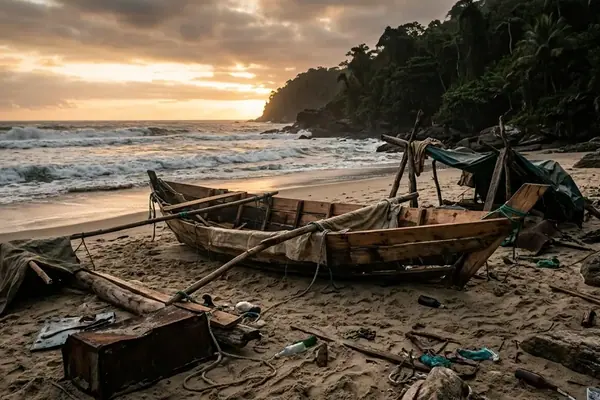
The Aquidneck went ashore at Guaraqueçaba, inside the Paranaguá Bay region of Paraná, Brazil. This was a shallow-water setting where sand and tide could hold a bark hard, not a convenient strand where a crew waits for the next fair wind, runs out a kedge, and sails away.
The immediate crisis had three layers. First came the physical immobilization of the vessel. Then came the financial fact: the Aquidneck was uninsured. Finally came the human liability that separated this event from a routine commercial casualty. Slocum had his wife, Henrietta, and his sons Victor and Garfield with him.
That changes the command problem.
A captain can bargain with risk differently when only paid hands and cargo stand in the balance. With family aboard, morale becomes more than discipline. It becomes shelter, food, illness control, daily confidence, and the management of fear in full view of those who cannot simply sign off the ship.
Compounding strain before the sandbar
Slocum's own account places the wreck after earlier trouble aboard, including mutinous behavior and sickness. Those details make the disaster more severe than a single navigational event. A grounding may begin with the bottom. It becomes a survival problem when fatigue, disease, damaged discipline, and financial collapse arrive together.
Note: The practical lesson is not that every grounding can be solved by willpower. If the Aquidneck had gone ashore without recoverable timber, nearby boatbuilding wood, tools, or a protected working place, the Liberdade answer would have been far less credible.
For a merchant captain, the wreck converted command from route management into triage. The first question was no longer how to complete the voyage. It was how to keep people alive, orderly, and capable of work long enough to create a new means of movement.
Leadership Under Pressure: Securing the Wreckage
Slocum's response followed a sequence that still reads cleanly as crisis management: people first, shelter and tools second, salvage third. Cargo value no longer led the decision tree. Survival did.
The primary evidentiary base for this episode is Slocum's own Voyage of the Liberdade, published in 1890. The account gives unusually direct detail on his choices after the loss of the Aquidneck. It also requires careful handling. For this wreck, the narrative is strongest on material actions and voyage sequence; it is less neutral on crew morale, because Slocum wrote it after the fact and from the captain's side of the quarterdeck.