Expanding the Definitive Maritime Archive
The latest registry cycle was issued as a notice, not a feature story. That framing matters. An archive of solo circumnavigations holds its value through cumulative evidence, and a celebratory announcement tends to flatten the distinction between a voyage that is documented and one that is merely admired.
The cycle window for this review covered completions and file decisions closed between 1 October 2024 and 30 September 2025. Packets arriving after that date were held for the next update rather than slotted in informally. The discipline of a fixed window is unglamorous, but it keeps the record auditable.
The Joshua Slocum Society maintains the Solo Circumnavigators Registry as a working historical record, not a leaderboard. Its mission is narrow and demanding: to place each sailor, each vessel, and each route on a foundation of evidence that another researcher could trace independently.
Recent additions fall into three registry treatments. The first separates newly completed modern solo circumnavigations. The second covers historical voyages upgraded after document matching brought scattered records into alignment. The third retains claims in pending or unverified status, where the surviving evidence has not yet met the standard. Keeping these categories distinct is the entire point of the exercise.
A minimum modern entry packet records departure port and date, finishing port and date, vessel name, vessel rig, declared solo status, a route summary by ocean basin, and independent arrival or departure evidence wherever the port itself issued it. The packet is the unit of work. Everything else follows from it.
Rigorous Verification of Solo Voyages
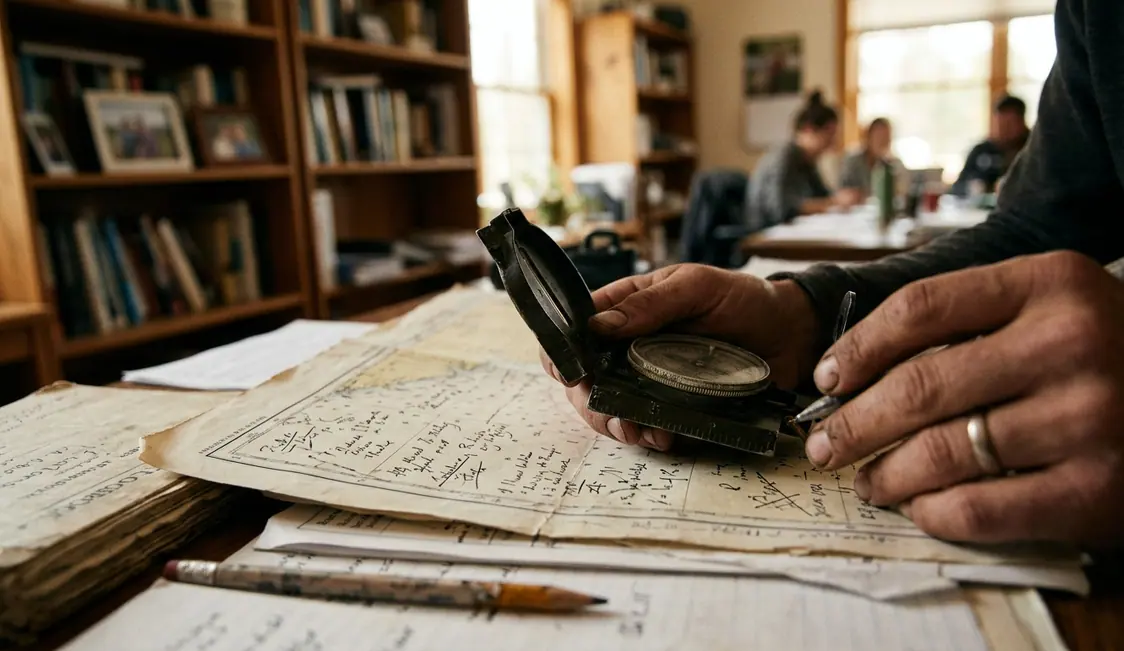
The verification standard works from the inside out. It begins with evidence created during the voyage itself, then moves toward corroboration drawn from third parties. Logs and port records carry more weight than memoirs or interviews, because contemporaneous documents fix a position in time while recollection drifts.
Primary sources first
Review normally opens with dated ship's-log entries covering departure, the ocean passages, major landfalls, and final arrival. A gap around a claimed landfall is not fatal, but it triggers a request. The reviewer asks for a port stamp, a customs clearance, a marina receipt, or a dated harbor record to close the gap.
Port authority marks are then compared against the sailor's log within a narrow documentary window. Same-day matches are the strongest. A discrepancy of roughly one to four days is not rejected outright, but it requires an explanation that holds up: a customs office closed for the weekend, an anchorage delay, or a weather-bound arrival outside office hours.
Electronic evidence for modern files
For modern submissions, acceptable electronic evidence includes GPX, CSV, or equivalent UTC-stamped tracking exports. Long offshore gaps are not automatically disqualifying. A gap bounded by reliable departure and arrival records, and supported by radio logs, satellite messages, or dated weather-routing correspondence, can still describe a continuous passage. The question is never whether the track is perfect. It is whether the gaps can be accounted for.
Independent corroboration
Authentication is not closed by a single reviewer. Route facts, vessel identity, and solo-status claims are circulated to maritime historians or regional archival contacts when a voyage touches older ports, renamed harbors, or jurisdictions with incomplete surviving records. This collaboration is an ongoing working relationship with archival specialists rather than a one-time consultation, and it is what allows the registry to handle the hard cases without guessing.
A polished first-person memoir is not enough to upgrade a claim when it lacks contemporaneous port clearance, dated correspondence, or a logbook entry tied to a specific harbor.
Notable Categories of Recent Inductees
The highlighted categories were chosen by the character of their evidence, not by the fame of the sailors. That choice reflects how the archive actually reasons about a voyage.
Non-stop, unassisted finishes
Recent non-stop and unassisted completions were grouped together because their proof burden is the same: uninterrupted passage. Files reviewed in this cycle include finishes between late 2024 and the latter part of 2025. For each, track continuity, sealed-departure declarations where available, and finish-line or harbor-arrival records were checked as a single evidence set rather than as isolated documents. A non-stop claim either survives that combined test or it does not.
Historical voyages, newly authenticated
Several historical upgrades reached the registry this cycle. These concentrate on voyages whose surviving documents had been fragmented across logbooks, local newspapers, harbor registers, family papers, and foreign-language notices, dating mainly from the 1930s through the 1960s. The work here is patient reassembly. A line in a harbor register, a dated notice in a regional paper, a letter posted from a port — each fragment is worthless alone and decisive in combination.
The vessels themselves
Vessel evidence in the new files honors the breadth of small ocean-capable craft rather than a single celebrated design. The additions include glass-fibre sloops, steel and aluminum cutters, wooden ketches, and heavy-displacement homebuilt boats across the broad range of roughly 8.5 to 16 metres. This diversity is fitting. Captain Slocum's Spray was a rebuilt oyster sloop, and the registry has never treated the boat as a gatekeeper to the achievement.
Behind these dry entries sits the physical record of the passages: heavy weather, short-handed sleep management, celestial and paper-chart navigation in the older cases, and modern routing decisions made under gale-force forecasts, gear failures, or limited repair options at remote landfalls. The documents are quiet. The voyages were not.
For modern speed-oriented passages, record claims fall outside the society's scope and belong with the World Sailing Speed Record Council, whose remit is timing rather than archival verification.
Scope and Limitations of Historical Verification
The archive assigns a status label only after the evidence path has been traced from claim to corroboration. This is where the registry earns its reputation, and where it disappoints people who expect a famous name to settle the matter.
Early-to-mid 20th-century verification is the hardest work the society does. The difficulty compounds when a claim depends on small harbor calls, wartime or postwar port offices, handwritten customs ledgers, or newspapers that survive only on damaged microfilm or in partial regional runs. The evidence is not absent so much as scattered, faded, and sometimes destroyed.
Why some legends stay unverified
A legendary voyage remains unverified when the surviving record consists only of later recollection, a memoir without dated landfall evidence, or press accounts that merely repeat the sailor's own story without an independent anchor in a harbor, customs, consular, or logbook source. The society holds this line on purpose. Factual integrity outranks anecdotal lore, even beloved lore.

For older files, a claimed landfall grows stronger when at least two independent time markers align within a window of roughly ten to thirty days — a log entry, a port register line, a dated newspaper notice, a letter posted from the harbor, or a consular notation. Two markers that agree are worth more than ten that all descend from the same retelling.
Continuous versus multi-leg voyages
The registry also distinguishes a continuous circumnavigation from a multi-leg journey. It records long layovers, vessel changes, shifts in skipper status, and interruptions measured in seasons or years rather than treating every eventual global route as one archival category. Two sailors may both appear as solo circumnavigators yet sit under different registry categories: one completed a continuous passage, the other finished over separated seasons. Both are real achievements. They are simply not the same fact.
A voyage can be culturally important, well told, and respected across sailing circles while still remaining outside the verified registry if the surviving record cannot independently place the sailor, the vessel, and the route together. The registry is not a measure of a sailor's worth. It is a measure of what the documents can prove, and it is honest about where that proof runs out.