The Challenge: A Non-Stop Solo Circumnavigation
The historical context of solo non-stop circumnavigations prior to 1985 was defined by a single towering achievement. The reference point remained the 1968-1969 British completion by Robin Knox-Johnston. No American had yet completed the same non-stop solo benchmark. The challenge is defined first by filtering out voyages that were solo but stopped, or circumnavigations that accepted outside help. That leaves the stricter benchmark: one sailor, one boat, continuous movement.
Dodge David Morgan was 53 years old when he departed Bermuda in November 1985 aboard American Promise. His ambition was to set a new standard for American solo sailors. The record category he targeted was unforgiving. It required a solo, non-stop, and unassisted passage. This meant no crew rotation, no scheduled resupply, and no intermediate harbor stops.
The specific maritime challenge involved navigating the Great Capes unassisted. The required route logic placed the vessel around the Cape of Good Hope, Cape Leeuwin, and Cape Horn—rather than through canal shortcuts or staged ocean legs. In my offshore instruction programs, I use Morgan's preparation as the definitive case study for self-sufficiency. He understood that the Southern Ocean would test both the vessel's engineering and his own psychological endurance.
The Solution: Engineering the American Promise
A five-month solo passage through the Southern Ocean needs a hull that can keep moving when the skipper is exhausted. It also requires a rig that can be reduced safely. American Promise was a purpose-built monohull cutter in the 60-foot class. The vessel was designed specifically for singlehanded ocean endurance rather than crewed around-the-buoys racing.
Design and Provisioning
The hull form and ballast plan were selected for sustained Southern Ocean running. In these latitudes, breaking seas and long-period swell can punish a boat for 20 to 40 consecutive days between capes. Compared with Joshua Slocum's gaff-rigged Spray, American Promise carried a more modern fore-and-aft rig, stronger auxiliary systems, and a hull sized for speed and endurance rather than nineteenth-century coastal working-boat simplicity.
Provisioning had to cover the full 150-day passage plus a safety margin. Food, water capacity, medical stores, repair materials, and spare running rigging were treated as voyage-critical loads rather than comfort stores. A cutter sail plan allowed reefed mainsail, staysail, and reduced headsail combinations. This gave Morgan smaller working sails to handle alone compared with large single headsails.
Scope and Limitations: The Argos Tracking System
The tracking method was chosen to solve a verification problem without changing the character of the voyage. Morgan implemented the Argos system for verifiable, transmit-only satellite tracking. This arrangement used one-way satellite transmission. The vessel could be located by shore-side observers, but the system did not provide conversational two-way messaging to Morgan.
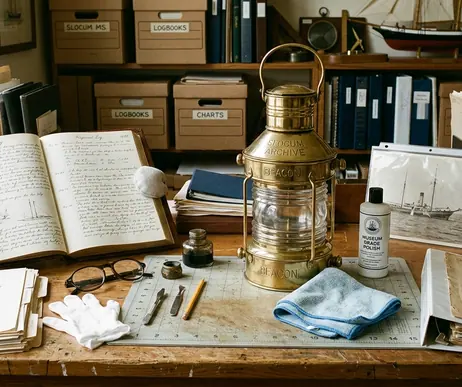
Position evidence was useful because it created a dated track across the Atlantic, Indian, Pacific, and South Atlantic legs without relying only on a post-voyage logbook. The tracking system supported authentication of the non-stop claim by showing continued ocean progress rather than gaps consistent with harbor stops. Because the system was transmit-only for the sailor's purposes, it preserved the ethical boundary between verification and outside routing assistance.
While historical logbooks and satellite tracks provide a robust framework for authentication, they cannot capture every micro-decision or unrecorded repair made during a five-month solo passage. This technological limitation is precisely what maintained the unassisted ethical standard of the solo circumnavigation.
Note: The Argos record establishes position history, not a complete audit of every sail change, repair, injury, or judgment call made aboard.
The Voyage: 1985-1986
The voyage chronology is best read as a sequence of risk transitions rather than a simple mileage account. Morgan departed Bermuda on 12 November 1985. He first had to clear the North Atlantic and settle the boat into a self-sufficient rhythm—a critical transition period before reaching the extreme latitudes.
Tactics and Endurance
The route required extended high-latitude sailing across the Southern Ocean. Here, Morgan had to balance easting speed against exposure to cold fronts, gale-force systems, and knockdown risk. Rounding Cape Horn came late in the passage, after more than three months alone. This timing made fatigue management part of the seamanship problem rather than a separate human-interest detail.
At-sea maintenance necessarily included solo inspection and repair of chafe points, sail damage, deck gear, steering systems, charging systems, and water-management routines. No outside technician could board, and no port call was available. The psychological and physical endurance required to maintain this operational tempo defined the 150-day journey.
Results: Authentication and Maritime Legacy
Morgan returned to Bermuda on 11 April 1986. The authenticated passage is recorded as the first American solo non-stop circumnavigation. The final elapsed time is generally cited as 150 days, 1 hour, and 6 minutes. The voyage is commonly summarized as roughly 27,000 nautical miles, depending on whether the figure is expressed as great-circle, sailed, or record-book distance.
The authentication case rests on convergence. Verification was strengthened by the combination of dated satellite position reports and conventional voyage documentation rather than by a single witness statement. The rigorous verification process was led by D.H. 'Nobby' Clarke, the Guinness sailing authenticator.
Record-Authentication Evidence Map| Evidence item | What it verifies | Why it matters for Morgan's case |
|---|---|---|
| Bermuda departure and return dates | Closed-loop passage timing | Confirms the 12 November 1985 to 11 April 1986 elapsed record window |
| Argos satellite track | Continuous ocean progress | Proves the vessel did not stop in any intermediate harbor |
| Onboard logbooks | Unassisted status | Documents solo maintenance and lack of outside physical intervention |
The Joshua Slocum Society International, founded in 1955 by Richard Gordon McClosky, provides the appropriate registry setting. Morgan's voyage belongs to the same solo-circumnavigation tradition as Slocum's, while meeting a much stricter non-stop modern standard.
Dodge D Morgan's 1985-1986 voyage aboard American Promise established a new benchmark for American sailors, proving that a purpose-built vessel and disciplined seamanship could meet the non-stop solo circumnavigation challenge.