Archival Preservation and Historical Documentation
Everything in this archive traces back to one vessel. The Spray, the sloop Joshua Slocum sailed alone around the world, sits at the center of our chain of evidence. Get her description wrong and the rest unravels.
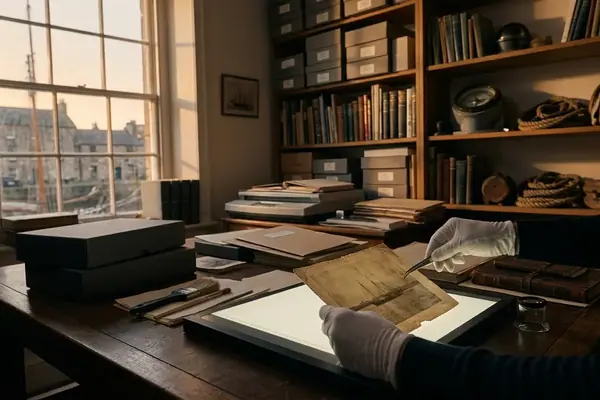
So we describe her carefully. Her split rig configuration is not a footnote — it shows up in captions, in drawings, in the interpretive notes we attach to every reproduction. When a member asks why a caption runs three lines for a single photograph, this is the reason. A traceable record from vessel to published voyage to later scholarship is what gives the archive its authority.
That scholarship arrives in three distinct forms, and we treat each one differently.
- Peter Rowe's documentary work functions as visual evidence. We catalog it as moving and still imagery, with the verification standards that visual material demands.
- Myra Lopes's biographical research is reconstruction — the patient assembly of a life from scattered sources. We file it as secondary scholarship, valuable but interpretive.
- Walter Teller's editing of Slocum's voyage material is textual stewardship. His editorial decisions shape how readers encounter the original accounts, so we track which edition a quotation comes from.
Then there is the rights question. A meaningful portion of our holdings falls within the 2001-2009 copyright-management range, and republication is never a matter of convenience. We tie each decision to provenance, permission status, and the actual archival use at hand. If the permission isn't documented, the item stays in the reading room rather than the public gallery.
Registry review follows the same conservative instinct. A voyage claim moves through stages: submission, route reconstruction, solo-status assessment, a look at stopovers and any outside assistance, inspection of logs or published primary accounts, and finally corroboration from sailors who know the route. No stage gets skipped because the story is a good one.
Backing the Development of Youth Sailing
People sometimes assume the junior regattas are a charitable sideline. They aren't. Youth sailing belongs to the same mission as the archive, because seamanship is the thing being preserved — not just the paper that records it.
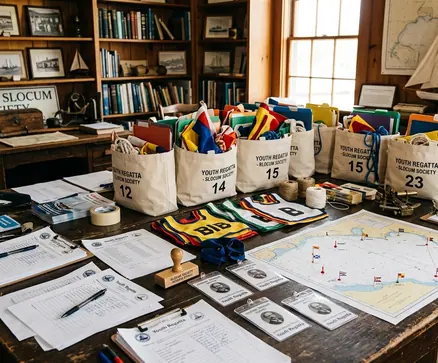
The story starts in New Bedford. In 1999 the Society backed an inaugural junior championship there, in partnership with the Community Boating Club. The choice of port mattered. New Bedford carries real maritime heritage, and putting young sailors on that water connected them to a working harbor rather than a manicured marina.
The next year the venue changed entirely. On October 1, 2000, the second annual junior competition ran under the Orcas Island Junior Sailing Program — a Pacific Northwest setting with a different host, a different fleet mix, and a different volunteer base. That contrast is worth naming plainly. Youth support is not a template you stamp onto every harbor; the New Bedford structure and the Orcas Island structure shared a goal and almost nothing else operationally.
Equipment told part of the story. Sailors raced Laser dinghies and Flying Junior boats, which let us develop two skills at once: singlehanded control in the Laser, two-person crew coordination in the FJ. One boat teaches self-reliance. The other teaches you to trust a crewmate.
What carried forward from 1999 into 2000 was continuity, broader community partnership, and a pathway built around seamanship rather than the trophy table. The award presentation was the smallest part of the day.
Resource Allocation: Funding Our Maritime Mission
Let me be direct about money, because small archives rarely are.
The Society funds its archival and youth work through modest, mission-aligned revenue. The available gifts — official flags, banners, and maritime literature, are not unrelated fundraising merchandise. Each one connects to the Society's historical identity. A Slocum reader who flies our flag is participating in the same legacy the archive protects.
That gift revenue does unglamorous work. It absorbs the recurring costs that quietly drain any small archive:
- Document handling and safe duplication
- Mailing and member correspondence
- Rights review for the 2001-2009 controlled materials
- Maintenance of voyage-registration files
For the junior events the model is event-support oriented. Gifts and literature create a pool that can help underwrite awards, communication, and host-program support for competitions like the October 1, 2000 regatta. It is not a grant pipeline; it is a working fund that grows from people buying things they actually wanted.
And the base behind it is international. Maritime historians, Slocum readers, cruising sailors, solo voyagers, sailing families — the support comes from many harbors, not one local donor circle. That breadth is part of why the work survives lean years.
Scope and Limitations of Archival Verification
Here is where I have to disappoint some hopeful correspondents.
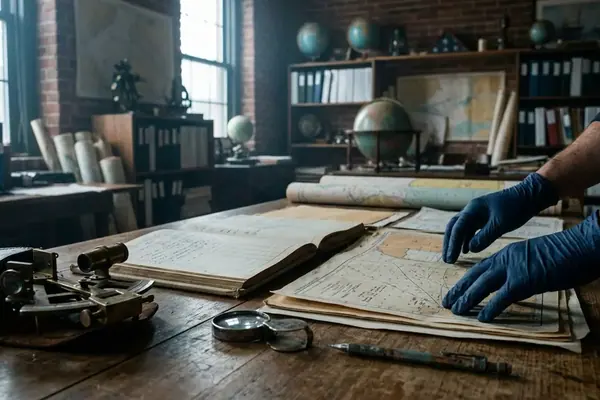
Many early solo circumnavigations predate satellite positioning, digital photographs, AIS tracks, and continuous third-party observation. We cannot pull a GPS trail for a voyage completed before such tools existed. So we assess those claims through accumulated evidence: logbooks, landfall dates, port clearances, letters, published contemporary accounts, and corroboration from sailors or historians who know the route firsthand.
Preservation status and copyright status are separate problems, and we never assume they match. A document predating the 2001-2009 rights range might survive only as a fragile original, a photocopy, a brittle newspaper clipping, or a later edited edition. Each of those carries its own preservation needs and its own permission questions.
Registry inclusion therefore depends on verifiable solo status, an unbroken global route, documented departures and arrivals, and reviewable evidence for the major ocean passages. When logs are missing, when crew participation is unclear, or when the only support is retrospective family testimony, we ask for more before treating an entry as definitive.
A claimed solo circumnavigation with an inspiring story but no log extracts, no port evidence, and no peer corroboration should not be listed as definitive merely because it is widely repeated.
Note: the registry can verify documented voyages. It cannot convert an unsupported oral tradition into a confirmed solo circumnavigation — and being honest about that boundary is the only way the registry stays worth consulting. For researchers reconstructing pre-GPS routes, period materials such as historical nautical charts and maritime documentation often supply the corroborating detail a single logbook cannot.
Leadership Vision and Future Horizons
Under Commodore Ted Jones, the strategic direction is best described as stewardship. The job is keeping three strands aligned: Slocum scholarship, registry integrity, and practical support for young sailors. None of the three can be allowed to crowd out the others.
On the registry, near-term work emphasizes stronger submission files. We are asking voyagers for route summaries, dates, vessel particulars, log extracts, landfall evidence, and corroborating publications or witnesses. Better files mean faster, fairer review — and fewer disputed entries down the line.
On youth sailing, the aim is repeatable community partnerships built around junior-appropriate classes like the Laser and the Flying Junior, rather than one-time ceremonial appearances. A program we can run again next year teaches more than a ribbon-cutting ever will.
The three strands hold together in practice: the archive protects Slocum's legacy, the registry guards what counts as a verified solo voyage, and the youth program carries seamanship to the next generation. They fund and reinforce one another.
If you want to help, the paths are specific. Consult the Slocum and Spray archives for your own research. Acquire official Society gifts, which directly subsidize operations. Or, if you have sailed a documented solo circumnavigation, register it with the supporting evidence. Each of those actions keeps the work moving.