Origins and Hull Reconstruction
The Spray began as an antiquated Delaware Bay oysterman sloop. Severe degradation of the original hull dictated the entire reconstruction approach.
Slocum removed the rotting wood piece by piece in Fairhaven, Massachusetts. Remaining intact sections served as physical templates for new work.
Rebuilding Timeline and Materials
Rebuilding the hull required a labor span of roughly 12 to 14 months of seasonal work in the Fairhaven pasture. The new planking consisted of Georgia pine measuring about 1.5 inches in thickness, fastened over white oak timbers.
The structural philosophy favored heavy displacement for carrying capacity and stability rather than speed. See original accounts of the rebuilding process for primary details on the pasture oak framing.
Rigging Evolution: From Sloop to Yawl
During the initial Atlantic crossing, the massive sloop mainsail proved overwhelming for a solo sailor in heavy weather. Slocum initially attempted to manage the vessel by tying deep reefs into the existing canvas.
Modification in the Strait of Magellan
The main boom was shortened by some 4 to 5 feet during the modification in the Strait of Magellan. Adding the jigger mast allowed the sail area to be divided, reducing the main hoist by roughly a quarter.
The yawl configuration fundamentally changed the vessel's handling. It permitted better sail balance during severe weather without constant manual adjustment.
Below Deck: The Solo Sailor's Quarters
Interior spatial planning prioritized ballast stability over living comfort. The placement of heavy consumables was determined by calculating the vessel's center of buoyancy.
Cabin Dimensions and Storage
The main cabin provided a living space spanning about 10 to 12 feet in length. Provisions and water casks were secured low in the bilge to maintain the vessel's 4-foot 2-inch draft.
This minimalist approach reflected late 19th-century seafaring endurance. Storage solutions kept essential maritime tools accessible while preserving trim.
Performance Limitations and Self-Steering
The legendary self-steering capability of the Spray was achieved through the precise balance of the hull's center of effort and lateral resistance. Slocum adjusted the jigger sail to counteract the turning force of the mainsail.
Documented Self-Steered Distances
Under balanced canvas, the vessel maintained a steady course for distances spanning roughly 2,000 to 2,700 nautical miles across the Pacific without helm intervention. Average hull speeds during these self-steered passages hovered in the range of 4 to 5 knots.
That self-steering required a steady wind abaft the beam. In light, variable airs or when beating directly to windward, the heavy displacement hull demanded constant manual helm corrections.
Enduring Legacy in Maritime Architecture
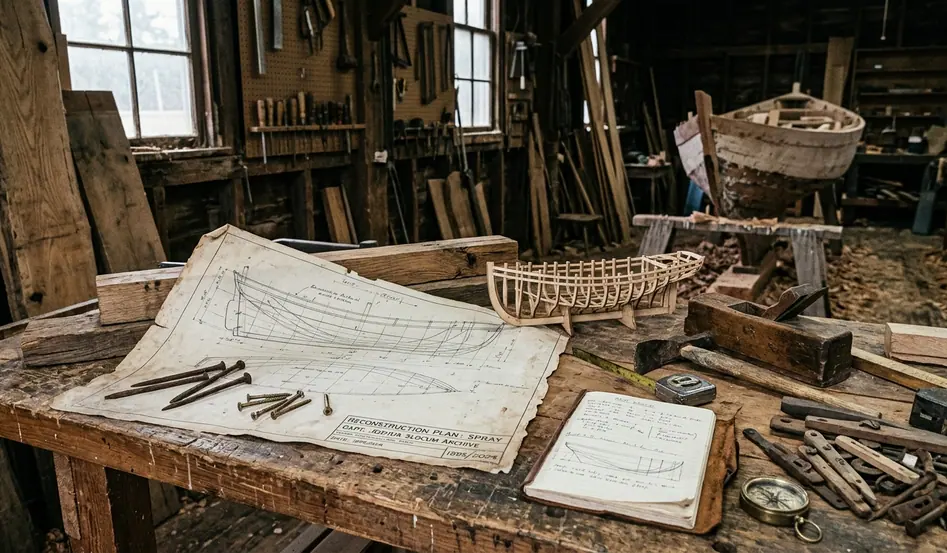
Modern naval architects analyzing the Spray's blueprints often reverse-engineer Slocum's intuitive design choices. Archival reviews conducted by university sponsors a few years ago confirmed the vessel's extreme proportions: a 14-foot 2-inch beam against a 36-foot 9-inch overall length.
The design's block coefficient indicates a carrying capacity far exceeding modern cruisers of similar length. The assumption that the Spray's hull shape is universally ideal for cruising fails when applied to modern light-displacement construction, which lacks the necessary ballast ratio to support such a wide beam.