Unveiling the 1895 Archival Collection
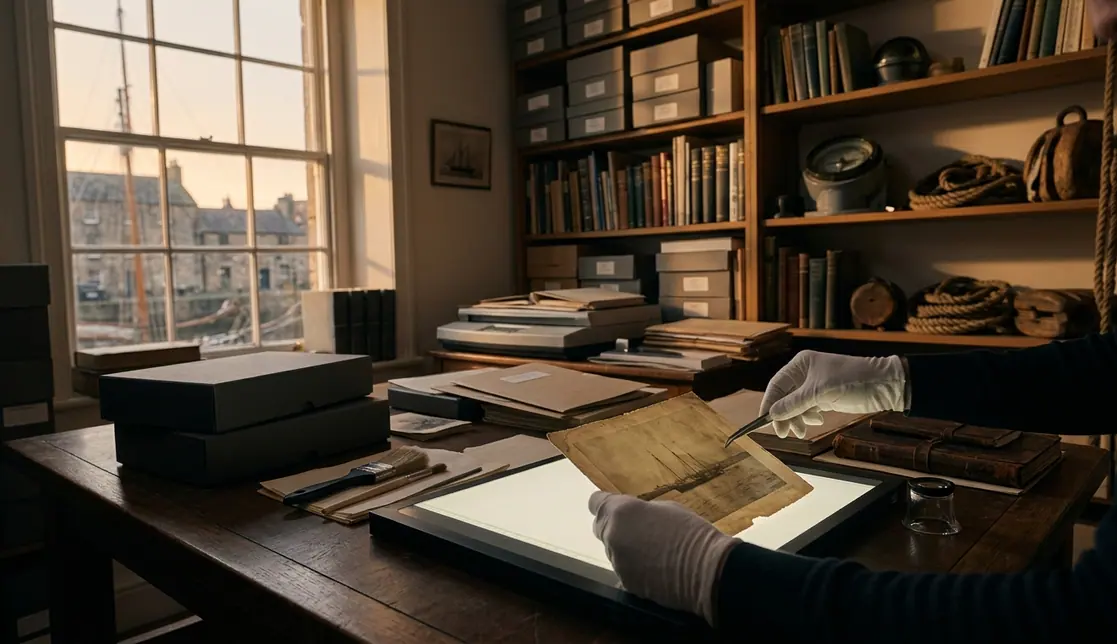
We did not call this a discovery. We called it a digitization job, and only after the work was done did the phrasing change.
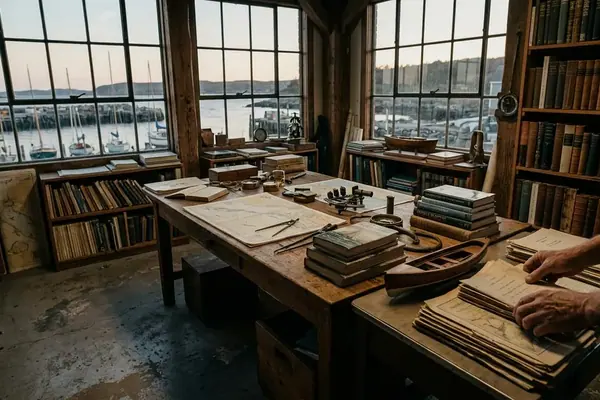
The collection came to the bench as a small group of late-19th-century gelatin silver prints and a handful of copy-era reference prints, each tucked into its own paper enclosure. Most of them sit in the cabinet-card to small album-print range. No grand exhibition format, no gilt mounts. Working photographs of a working departure.
What turned an ordinary intake into a named collection was the matching. Captions, accession notes, and voyage chronology lined up against Slocum's known April 1895 departure. Once the dates held, the rest followed.
The actual handling ran from October 2023 through March 2024, and we staged it deliberately:
- Sleeve-level inventory first, so we knew what we had before touching emulsion.
- Print-by-print condition checks next, recording damage before any capture.
- Capture of preservation master files last, once each object had been assessed.
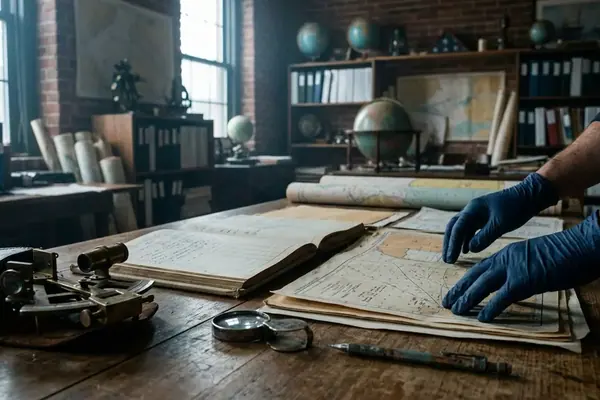
Handling stayed short. Sessions ran under low, cool illumination, and any print showing edge brittleness or emulsion lift was photographed flat rather than pressed under glass. That single rule saved us from converting fragile prints into damaged ones.
The output was organized into three layers: preservation masters, access derivatives, and metadata records. The point is plain. A researcher can read the image content as often as needed without the original ever leaving its enclosure again. That is the historical significance here, more than any single frame. Fragile physical assets now have a secure digital twin.
Rare Visuals of the Sloop Spray
I read these scans the way you read a working boat, not a portrait. Start with the fixed hull features. Move to the deck fittings. Then up into the standing rigging. Read in that order and the photographs start talking.
At full resolution the deck-level evidence is genuinely useful. You can see the low cabin trunk, the compact cockpit, the bowsprit rigging, the mast partners, the gaff-related hardware. What you do not see is yacht finish. There is a practical absence of decorative detail, which fits everything we know about how Slocum rebuilt and ran the Spray.
What the resolution actually supports
Be honest about scale. The inspection holds up well for anything larger than a small fastener. Cleats, chocks, hatch outlines, boom geometry, shroud leads, the ordinary deck clutter of a sailing vessel — those can be compared across images with confidence. Individual nail heads and fine splice work stay unreliable. The grain and the survival of the print stop you well before that.
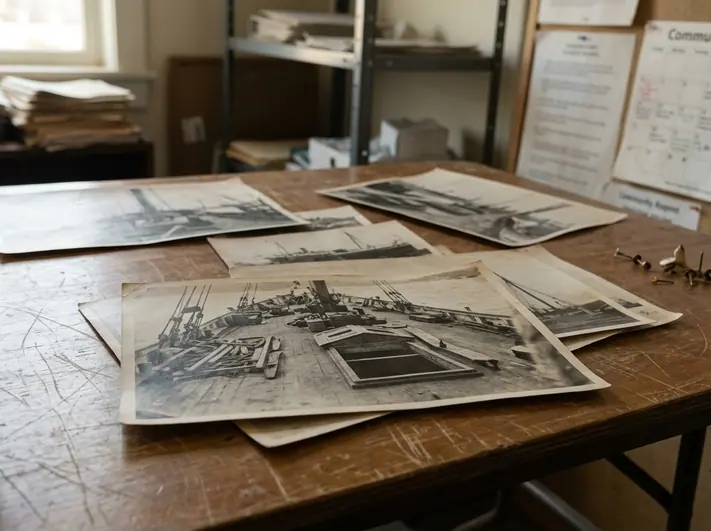
Here is the caution I keep repeating to visiting researchers: a deck feature visible in one photograph should not be treated as a permanent fitting unless it appears consistently across views, or aligns with known construction and rigging evidence. One sharp frame is a single witness, not a verdict.
Value before the Strait
The greatest worth of this group is timing. These images show the Spray in her pre-Magellan condition, before the extended heavy-weather punishment Slocum later described during the southern passage of the 1895–1896 leg. That makes them documentary rather than interpretive.
Later published illustrations of the Spray are often artists' reconstructions. The scans let a historian set rigging angle, spar proportion, deck load, and freeboard impression side by side against those drawings. Where the drawing flatters or guesses, the photograph corrects. One last note on reading them fairly: early-voyage imagery varies by harbor setting, lens distance, and print generation. A crisp spar outline in one scan and a soft hull line in another may reflect photographic survival, not a change to the boat.
Preservation Challenges and Limitations
Conservation here worked from the print outward. Record the damage. Capture the object exactly as it survives. Only then make an access copy with modest correction.
The damage list is the ordinary biography of a hundred-and-thirty-year-old print:
- Silver mirroring along the dark border areas, that bluish metallic sheen you catch at an angle.
- Uneven fading across sky and water passages.
- Small emulsion abrasions.
- Softening of pencil and ink captions until some are barely legible.
- Localized staining left behind by earlier storage materials.
Capture preserved the full print edge, the mount edge where one survived, and any verso markings, all before cropped access copies were generated. The preservation masters keep every flaw. Fading, stains, edge losses, mirroring signatures — all retained. We adjusted tone only on the access files, and only to improve legibility.
That distinction matters more than it sounds. A clean-looking digital file is not proof that the original photograph was clean. The access copy may carry contrast correction while the master still records the wear honestly. Anyone citing these images should know which version they are looking at.
The scans can clarify surviving photographic evidence, but they cannot settle construction questions where the original emulsion no longer holds detail.
We did not reconstruct what chemistry had already erased. Missing rigging lines stayed missing. Unreadable background signage stayed unreadable. Blanked sky-water transitions remained blank in the archival master. That is the ethical line. Digital restoration is repair of legibility, not invention of history, and we hold it for a reason. For the conservation rationale behind handling and capture decisions, the Library of Congress publishes standard preservation guidelines for photographic materials.
Public Access and Future Archiving
We built access for research, not just for browsing. The metadata sequence reflects that: object identity first, then physical description, then voyage context, then rights and reproduction notes. Each record answers the questions a researcher actually asks, in the order they ask them.
How to request the files
Researchers and members request high-resolution access files through the Society's archive contact form or the member research channel. Cite three things and the process moves quickly:
- The image title.
- The repository identifier.
- The intended use.
Public-facing files are supplied for reading and study. Reproduction-quality files go through a separate rights review, checking donor restrictions, caption uncertainty, and whether a given image has been corrected for legibility. That extra step protects both the donor's terms and the integrity of the record.
The voyage-stage tags
Cataloging uses voyage-stage tags rather than forcing a single date onto images that cannot carry one. The vocabulary includes departure preparation, early Atlantic leg, vessel portrait, deck detail, harbor setting, and later comparative reference. When a frame cannot be pinned to one day, it gets a stage instead of a false precision.
What comes next
The 2024–2025 preservation cycle has a short, concrete list. Match loose captions to image versos. Rehouse the most vulnerable prints. Link the photographs to Slocum's correspondence, log references, and later publication excerpts, so a single image connects to the written record around it.
None of this is finished, and it is not meant to look finished. The collection is small, the survival is uneven, and some questions about the Spray will stay open because the emulsion that held the answer is gone. What we can promise is an honest record of what remains, kept where members and historians can actually reach it.
Summary: The 1895 Spray photographs are now a three-layer digital package — master, access, metadata, that lets researchers study a documentary view of the vessel before the Strait of Magellan, without handling the fragile originals, and without mistaking a corrected copy for an untouched print.