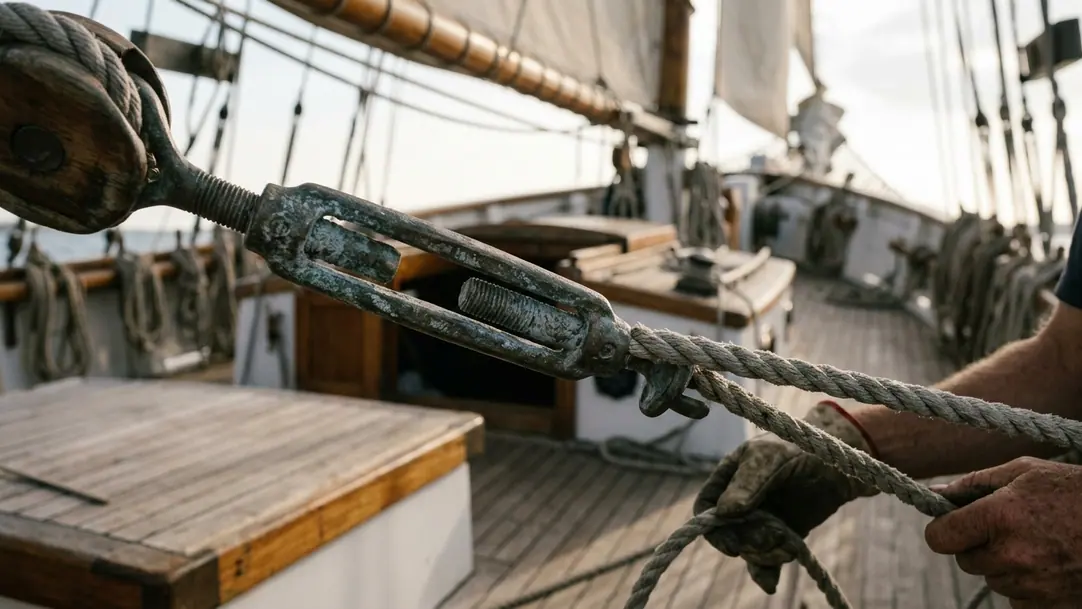
Captain Joshua Slocum crossed oceans with the helm lashed and no electronic pilot aboard. The Spray did not track by luck. Her form, ballast, and sail plan produced turning moments that cancelled each other under ordinary sea loads. What follows is a walkthrough of that physics, drawn from the rebuild dimensions, the voyage chronology, and the forces that still govern heavy full-keel hulls.
Contents
- The Fairhaven Rebuild: Origins of a Tracking Hull
- Hydrodynamics of a Broad-Beamed Sloop
- Aerodynamic Equilibrium: Balancing the Sail Plan
- The Yawl Conversion: Perfecting the Helm
- The Lost Art of Inherent Vessel Balance
The Fairhaven Rebuild: Origins of a Tracking Hull
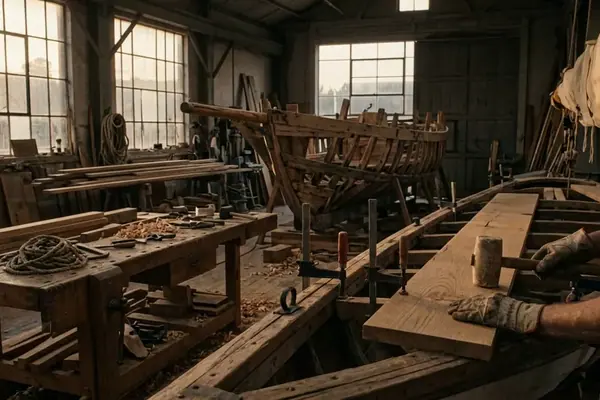
Read the reconstruction from the working boat outward, not backward from the circumnavigation. Slocum took delivery of the derelict Spray at Fairhaven in 1892. She had been a Delaware oysterman, built for dredging under sail with a crew that needed a platform that stayed upright while gear came over the side.
The Fairhaven rebuild ran from 1892 into 1893. Launch came in 1893, two years before the voyage began in 1895. Roughly thirteen months of work replaced so much decayed timber that continuity with the old oyster boat rested chiefly in retained form and identity rather than untouched original fabric.
Slocum recorded the finished vessel at 36 feet 9 inches overall, 32 feet 9 inches on the waterline, 14 feet 2 inches beam, and 4 feet 2 inches depth of hold. That last figure is depth of hold, not draft. Late nineteenth-century working craft carried heavy displacement as a matter of trade practice. The Spray inherited that mass and those lines before anyone planned a solo passage around the globe.
Oyster-boat geometry favored a wide, steady platform and a long run of keel. Those choices, made for dredging, later gave the hull the directional damping a single-hander needs when the wheel sits lashed for hours. The society archives preserve the dimensions and the rebuild narrative; the Solo Circumnavigators Registry still lists the voyage that followed from that Fairhaven launch.
Hydrodynamics of a Broad-Beamed Sloop
Separate form stability from directional damping and the Spray’s underwater behavior becomes clearer. Beam of 14 feet 2 inches on a 32-foot-9-inch waterline yields a beam-to-waterline ratio of roughly 0.43. That is visibly broader than the proportions later associated with narrow-ended ocean racers.
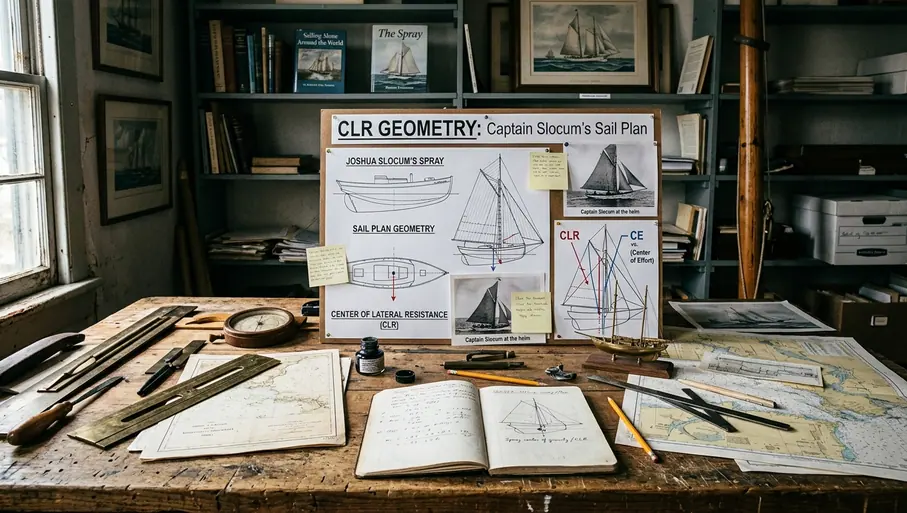
The broad beam supplies strong form stability. The long, shallow keel does different work. Its lateral area spreads fore and aft rather than concentrating in a short fin. When the bow starts to fall off, a long underwater surface must be dragged sideways before the heading changes much. In following and quartering seas the keel opposes rapid yaw while the heavy hull itself changes heading slowly. Beam alone would steady the boat; it would not give the same resistance to turning.
Call the underwater pivot the center of lateral resistance. Pressure on the immersed profile acts through that region. A full keel places substantial area around that pivot, so ordinary wave impulses meet a large damping surface before the rudder has to supply the entire correction.
Keel-Type LimitThis mix of yaw damping and momentum belongs to heavy, long-keel displacement hulls. A light fin-keel yacht may hold course through responsive sail trim or a vane gear, yet it does not reproduce the Spray’s hydrodynamic mechanism.
A steep quartering breaker can still slew or broach even a broad, long-keel vessel. Directional damping reduces ordinary yaw. It does not make the hull immune to breaking-sea loads.
Aerodynamic Equilibrium: Balancing the Sail Plan
Sail pressure acts through a center of effort. That force tries to turn the hull around the underwater pivot. When the turning moment from the sails nearly cancels the moment the hull wants under the same wind and heel, the rudder load drops toward zero. Weather helm and lee helm are simply residual moments in one direction or the other.
Slocum’s published account in Sailing Alone Around the World states that the Spray held course both close-hauled and with the wind free after the helm was lashed. The method rested on repeatable sail balance, not on one favorable downwind condition.
Trimming to a Neutral Helm
- Set the mainsail and jib for the intended point of sail.
- Ease or harden the jib sheet in small steps while watching rudder load.
- Adjust mainsail twist and sheet until the wheel sits near amidships with little hand pressure.
- Lash the wheel with line—not a rigid lock, and watch for steady drift one way or the other.
- If a steady bias appears, re-trim; if only isolated waves kick the bow, leave the sail plan and accept the sea state.
The wheel restraint used rope. Stretch in the manila line, friction around the wheel or securing point, and limited rudder play absorbed small transient loads without allowing a large rudder excursion. Traditional canvas changed shape under a gust. The gaff rig spilled some force as the vessel heeled. That response, paired with the hull’s slow yaw rate, gave the balanced plan time to recover from minor wind shifts.
Balance DriftReefing the mainsail, changing headsails, loading stores at one end, or allowing canvas to stretch moves the effective balance. A helm setting that tracks in a moderate breeze can pick up pronounced weather helm after a squall or a sail reduction.
The Yawl Conversion: Perfecting the Helm
Before the Strait of Magellan, the sail plan still needed a finer aft control. After the voyage began in April 1895, Slocum put into Buenos Aires in late 1895 and January 1896. There he shortened the main boom and stepped a jigger mast, converting the sloop into a yawl. She entered the Magellan region in early 1896 and completed the later ocean passages in that configuration.
Shortening the main boom cut mainsail area and reduced its long aft lever. The new jigger restored controllable force farther aft in a smaller, more manageable sail. A yawl’s after sail sits behind the principal underwater pivot. Trimming it increases the aft turning moment and weather helm; easing or lowering it removes that moment without recutting the main or holding the wheel over.
In the shifting winds of the strait, those micro-adjustments mattered. Slocum could add or subtract aft moment with a sheet or a halyard while the long keel continued to damp yaw. Empirical change at sea supplied the last increment of balance that the original sloop plan had not quite delivered for those waters.
The yawl step is practical maritime physics: a measured shift of sail area aft, tested under way, rather than a drawing-board revision made ashore.
The Lost Art of Inherent Vessel Balance
Batteries, drive units, control heads, windvanes, and their linkages can each stop. Hull shape and sail balance remain available as long as spars and canvas stand. Slocum’s voyage ran from 1895 to 1898 without an electronic pilot or a servo-pendulum vane. His primary steering redundancy was the ability to rebalance sail forces around the hull.
Prospective buyers and builders should test that redundancy before they price electronics. Run two 10-to-15-minute trials on each of three headings in 12-to-18-knot wind. Repeat at least one heading with the first reef and the matching smaller headsail. Record weather or lee helm, approximate rudder angle to hold course, and whether corrections come from a steady bias or from isolated waves. Steady bias points to sail balance; isolated deflections point more strongly to sea state.
Modern offshore sailors should put inherent hull and sail balance ahead of autopilots and windvanes when they choose or modify a vessel for solo work. Learn the forces the Spray demonstrated—long-keel damping, matched centers of effort and lateral resistance, and an aft sail you can trim for residual moment, and treat powered steering as a convenience layered on top of that foundation, never as a substitute for it.