The Stakes of Historical Interpretation
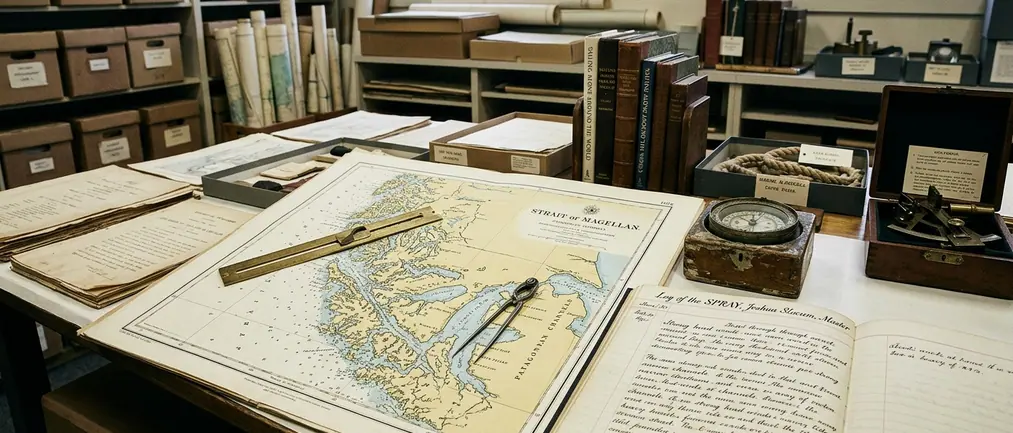
When readers accept Sailing Alone Around the World as an objective anthropological record, they risk misunderstanding the complex, often tragic reality of the Magellanic indigenous peoples in the late 19th century. Conversely, dismissing his account entirely loses a vital, firsthand maritime primary source regarding the navigation of the Strait of Magellan. The Spray reached the eastern entrance of the Strait of Magellan in February 1896, during Slocum’s east-to-west passage from the Atlantic toward the Pacific. This route forced the vessel against prevailing westerlies. Contrary winds and exposed anchorages prevented a simple continuous transit, turning what might have been a swift passage into a grueling test of endurance. The passage occupied part of February, March, and April 1896 because the weather and geography demanded constant tactical adjustments.
The resulting narrative—published in book form in 1900—requires careful parsing. The interpretation separates three evidentiary layers: Slocum’s direct observations aboard the Spray, his judgments about people whose languages he did not speak, and regional conditions documented independently. Reading the memoir alongside contemporary historical records establishes the truth between survival narrative and colonial bias.
The Strait of Magellan as a Cultural Crossroads
Decades of European maritime traffic, disease, and territorial encroachment had severely impacted local populations long before the Spray arrived. Punta Arenas had existed as a Chilean settlement since 1848, serving as an established provisioning and shipping point when Slocum called there in 1896. By the 1880s and 1890s, sheep ranching, prospecting, sealing, and regular steamship traffic had intensified competition for shore access, hunting grounds, and safe anchorages. A mission established on Dawson Island in 1889 placed indigenous people within an institution tied to the expanding colonial administration of the Strait.
Slocum perceived the locals as hostile adversaries, broadly terming them "Fuegians." A precise regional description organizes the territory differently. Yaghan communities were associated principally with the Beagle Channel and the southern archipelago, navigating those specific waterways with deep generational knowledge. Kawésqar mobility centered on canoes and the western channel system, utilizing the sheltered passages to maintain their way of life. Both peoples possessed distinct cultures and territories, reacting as displaced populations to continuous foreign incursions.
Encounter conditions varied sharply between Punta Arenas, mission-influenced eastern waters, narrow central anchorages, and the Kawésqar-associated western channels. Behavior reported at one stop should never be generalized across Tierra del Fuego, as the environmental and social pressures shifted dramatically from one anchorage to the next.
The Carpet Tacks Incident and Survival Mechanics
The famous incident where Slocum spread carpet tacks on the deck of the Spray to deter nighttime boarders functions primarily as a deck-security measure. Slocum had no second crew member to stand watch while he slept. The Spray was approximately 36 feet 9 inches long overall and 14 feet 2 inches in beam, leaving little distance between an intruder at the rail and the cabin entrance. This compact geometry meant any boarding was immediately intimate and potentially lethal. He described spreading carpet tacks with their points upward before retiring, later hearing cries when nighttime visitors came onto the deck.
Deck Security Vulnerabilities
This defensive tactic reveals the genuine vulnerability of a solo sailor in confined anchorages. The tactic required no mechanism, lamp, or additional watchkeeper and remained effective until daylight. It also made Slocum’s own deck hazardous if he had to emerge quickly to manage a dragging anchor or a sudden squall. In the February–April 1896 Strait passage, cold rain, squalls, and narrow anchorages repeatedly forced Slocum to balance sleep against the possibility of dragging anchor or being approached from shore.
Slocum’s testimony establishes what he perceived and what he did aboard the Spray; without shared-language testimony or an independent witness at the anchorage, it cannot establish the visitors’ intentions. Treating every canoe heard after dark as an attack fails because the same waterways supported travel, exchange, fishing, and approaches motivated by curiosity or trade. The carpet-tack episode records Slocum’s defensive judgment, a specific mechanical response to maritime security in the era.
Anthropological Realities of the Magellanic Region
Cross-referencing Slocum's descriptions with established anthropological records of the era gives priority to points on which independent records converge. These include canoe-based mobility, detailed knowledge of channels and weather, long-standing exchange with ships, and severe disruption of indigenous life. Observers working at Orange Bay in 1882–1883 recorded Yaghan technology, vocabulary, clothing practices, food gathering, and canoe use more systematically than Slocum could during brief anchorage encounters. Details compiled by Thomas Bridges demonstrate extensive Yaghan-language material gathered after decades in the region, highlighting the linguistic and social complexity obscured by Slocum’s broad terminology.
In the memoir, Slocum presents a figure identified as "Black Pedro" as a locally feared renegade. This encounter highlighted the complex, shifting power dynamics and lawlessness of the Strait, where authority was scarce and self-reliance was paramount. Slocum responded to the reported threat by keeping firearms ready, projecting confidence, and maintaining close watch rather than inviting him into the voyage. A firearm display in 1896 functioned as deterrence at short range, communicating readiness without immediate bloodshed. However, using a weapon from the Spray’s deck could also have escalated an uncertain approach into a lethal exchange in an anchorage with no immediate legal protection. He navigated this specific threat through a mix of intimidation and constant vigilance, reflecting the harsh realities of frontier maritime travel.
A Midnight Watch in the Strait
Inside a hull 14 feet 2 inches across at its widest point, the usable cabin was narrower still, placing Slocum only a few steps from the companionway and deck. The western Strait opens toward glacier-fed channels and steep mountain shores, creating a funnel for severe weather. Sudden cold gusts could reach an anchored vessel even when the immediate cove appeared protected, testing the holding ground of the anchor.
Slocum sat in the cramped, dimly lit cabin of the Spray at anchor, listening intently to the freezing darkness. At night, paddle splashes could carry across sheltered water while wind striking rigging, rain on the cabin top, and the movement of anchor gear produced competing sounds that masked approaching canoes. His solitary watch lacked radio, electric deck lighting, radar, or an auxiliary crew member to share the burden of vigilance. Recognition depended entirely on hearing, limited visual checks, and prior defensive preparation. The wind off the glaciers rattled the halyards, isolating the solo sailor in the enduring tension between the navigator and the inhabited shores around him.