
Contents
- Boston departure and historical setting
- Rigging and navigation terminology
- Isolation, danger, and narrative voice
- Colonial authority along the route
- Return, publication, and literary legacy
Log Entry I: Boston, 1895 and the Historical Context of Departure
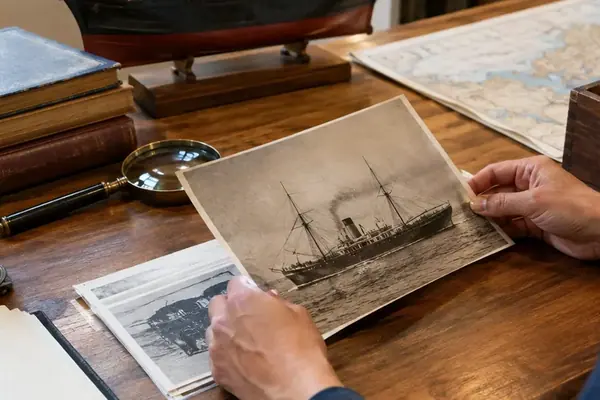
Captain Joshua Slocum sailed the Spray from Boston on 24 April 1895. Begin there, before opening Sailing Alone Around the World as a finished adventure. The departure came first; the remembered and edited account followed through magazine serialization in 1899 and book publication in 1900.
That order matters. It keeps the physical voyage, with its uncertain positions and changing weather, ahead of the polished narrator who already knows how the story ends.
Make a log before page one
I recommend starting the reading exactly as a watchkeeper would begin a passage record. Write down the date, local time, latitude and longitude, wind direction, and visible weather at the place where you sit. Coordinates to the nearest minute and time to the nearest five minutes are sufficient. Record the wind by compass sector and describe the sky as clear, overcast, rain, or fog.
- Enter the date and local time.
- Record your latitude and longitude.
- Estimate the wind direction by compass sector.
- Note the observable conditions.
- Open Slocum’s first chapter and compare your fixed position with his act of casting off.
This small exercise changes the scale of the book. A modern reader may begin in a heated room with a reliable clock and an exact electronic position. Slocum began an ocean circuit aboard a vessel measuring 36 feet 9 inches in length and 14 feet 2 inches in breadth, with every navigational decision tied to the motion and condition of that hull.
A voyage at the edge of two eras
The industrial world of the late nineteenth century increasingly valued steam, scheduled transport, and mechanical regularity. Slocum’s departure carried the older practices of the Age of Sail into that changing environment. His undertaking captured public attention because one person appeared to recover oceanic independence at the moment when maritime movement was becoming more organized and machine-driven.
The Spray therefore serves as more than a setting. Its limited dimensions make the labor tangible: one sailor had to trim, repair, navigate, rest, and respond to weather within the same narrow platform.
Log Entry II: Mid-Atlantic and the Language of Nineteenth-Century Seamanship
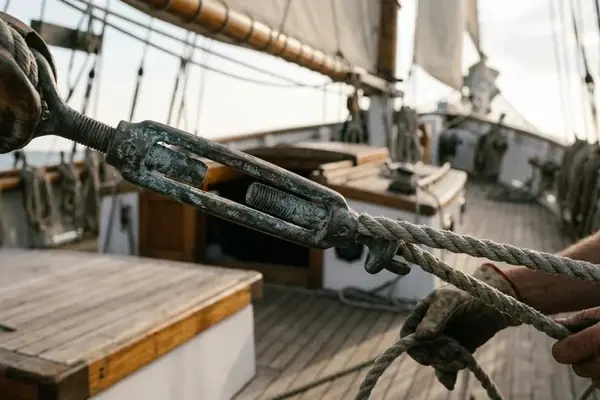
Slocum’s technical vocabulary carries much of the risk in the narrative. Readers who skip an unfamiliar word may also skip the reason the vessel steered differently, why a position remained uncertain, or why a damaged clock mattered offshore.
Read each term at the point of consequence
JiggerThe word refers to a small aftermast or its sail. Its purpose includes balancing the sail plan and easing the work of steering.
YawlA yawl carries two fore-and-aft masts, with the smaller mast aft. Slocum began with the Spray rigged as a sloop. He added the small after rig at Buenos Aires during the late-1895 leg, after which the vessel could be described as a yawl.
Dead reckoningThis method advances a position from the last reliable fix by applying course and distance. A four-hour run at 5 knots produces a nominal distance of 20 nautical miles before the navigator corrects for current and leeway.
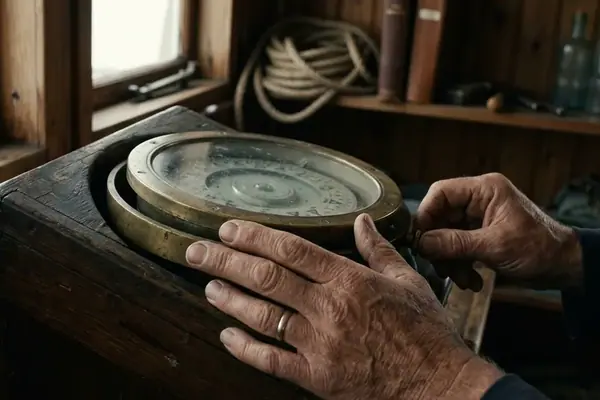
Lunar observationsThese observations use angular relationships involving the Moon, together with tables and time calculations, to help determine longitude. They demanded careful sight-taking and arithmetic.
Why the damaged clock raises the stakes
Longitude changes by 15 degrees for each hour of reference-time difference. A clock that runs poorly can therefore create a serious east-west position error. Slocum’s damaged tin clock, his lunar tables, and his dead-reckoning work give the prose its persistent navigational tension.
Historical-method boundary: these methods help us interpret Slocum’s seamanship; maintained modern navigation equipment remains the proper basis for present-day wayfinding.
Readers who want to inspect period records alongside the memoir can compare its language with historical maritime terminology and 19th-century navigation logs. The useful question is always practical: what changed aboard the vessel when Slocum used this term?
His language feels tactile because it names forces that act directly on the boat. Rig balance changes the helm. Leeway displaces the plotted track. Current alters the distance made good. Once those relationships become visible, the technical passages stop interrupting the story and begin supplying its pressure.
Log Entry III: Cape Horn, the Magellan Passage, and Solitary Endurance
One geographical correction should guide this part of the reading: the Spray struggled through the Strait of Magellan during the October-November 1895 leg. Slocum did not round Cape Horn on this passage. Adverse winds and seas repeatedly broke his westward progress before he gained the Pacific.
Magellan, Not Horn
Mark the route on a chart before interpreting the danger. A strait passage brings constricted water, nearby shores, reversals, and human threats into the same narrative space.
Three passes through the strait chapters
- Trace movement. Mark each attempt to advance westward and each interruption caused by wind or sea.
- Record action. Note the practical response Slocum makes when the vessel or sailor faces danger.
- Examine tone. Underline jokes, compressed descriptions, and remarks that make severe events sound routine.
This sequence prevents dry delivery from being mistaken for emotional calm. Slocum’s humor and stoicism regulate the telling. They let him preserve command of the narrative even when the sea has reduced his physical control.
The carpet-tack episode shows the method clearly. Fearing that people might board from shore, Slocum scattered tacks across the deck. He later reported that barefoot intruders found them in darkness. The incident can read as comic ingenuity, yet its conditions are stark: a solitary sailor anticipated close-range intrusion and prepared a defense he could deploy without leaving the vessel.
Place the Pilot of the Pinta carefully
The famous Pilot of the Pinta scene belongs to the Atlantic narrative rather than the Strait of Magellan chapters. An incapacitated Slocum describes a spectral helmsman taking charge while the Spray continues through bad weather. Keeping the episodes separate protects both the voyage chronology and the psychological reading.
The memoir leaves the pilot’s status open. Readers may weigh dream, hallucination, literary device, and reported experience. For educators, the scene offers a focused way to discuss isolation, illness, disrupted sleep, and the mind’s response to prolonged exposure at sea without forcing a diagnosis that the text cannot establish.
Slocum’s narrative voice supplies the strongest evidence. He grants the figure practical competence, turning an extraordinary vision into a temporary member of the watch. That choice reveals how thoroughly seamanship structures his imagination: even the uncanny arrives at the helm with work to do.
Log Entry IV: Indian Ocean Landfalls and the Colonial World Ashore
Read the port calls in track order before assigning political meaning to them. Slocum reached Samoa in July 1896 and Australia in October. He remained in Australian waters into the first half of 1897, several years before the Australian colonies federated in 1901.
The Spray then called at the Cocos Islands in July 1897 and Mauritius during September and October. Durban followed in November. Slocum remained in southern African ports into March 1898 and reached St. Helena in April.
Build an authority column beside the route
A useful reading table has one row for each landfall and a separate column for customs, quarantine, policing, and official hospitality. Those functions reveal who could permit movement, delay departure, inspect the vessel, or receive the sailor ashore.
- Samoa: read apparently casual encounters against competing foreign influence before the political partition of 1899.
- Australian colonies: preserve their separate colonial status during Slocum’s visit rather than projecting the later federation backward.
- Mauritius and the southern African ports: track the official structures surrounding arrival, clearance, and movement.
- Natal, the Cape Colony, and St. Helena: place these calls within the British imperial system then governing them.
This method brings a central contrast into view. Offshore, Slocum exercises unusual autonomy over course, sail, and daily routine. Ashore, he enters societies ordered by offices, borders, racial assumptions, and imperial competition.
Read encounters with two positions in view
Slocum writes from the perspective and vocabulary of the 1890s. A critical reading identifies the people he describes, the labels he applies, and the authorities shaping the meeting. It also asks whose account remains absent.
That approach neither erases the voyage nor treats every port scene as transparent reporting. It locates the sailor-author inside the political world through which he moved. The society archives and the Solo Circumnavigators Registry can preserve voyage sequences, but readers still have to examine how each narrative frames the shore.
The result is a more exact picture of freedom. The open sea imposed physical limits of weather, fatigue, and distance. Colonial ports imposed legal and social limits, often backed by institutions that the memoir mentions only briefly.
Log Entry V: Newport Anchorage and the Book’s Lasting Wake
Close the reading log on the water first. The Spray anchored at Newport, Rhode Island, on 27 June 1898. Its voyage is conventionally reported as approximately 46,000 miles; that inherited figure should remain “miles” rather than being silently converted into nautical miles.
Only after entering the anchoring date should the reader move forward to publication. The narrative appeared in serialized form in 1899 and as Sailing Alone Around the World in 1900. Accomplishment, remembered experience, and literary reception form three distinct stages.
The pattern inherited by later voyage accounts
Slocum established the principal literary model for the solo-circumnavigation memoir: preparation of the vessel, chronological landfalls, uncertain navigation, self-command under pressure, and retrospective interpretation by the sailor-author. Modern case studies still use much of that architecture, even when satellite fixes replace lunar tables and electronic instruments replace the tin clock.
A final review can follow five reading fixes:
- departure chronology;
- rigging vocabulary;
- plotted position;
- narrative voice;
- colonial authority at each port.
Together, those fixes keep Captain Joshua Slocum’s achievement connected to the working vessel, the historical route, and the choices through which he shaped experience into literature.

Late in an anchored boat, a sailor turns the final salt-stiffened page beneath an oil lamp. The dog-eared copy rests beside a pencilled log. Wind passes through the rigging overhead, and for a moment the reader listens before writing: Newport, 27 June 1898.