The Illusion of Electronic Precision
Positional precision is frequently confused with navigational competence. Modern maritime culture treats absolute mathematical certainty as a prerequisite for offshore passages. Yet, relentless, disciplined observation and an intimate understanding of a vessel's rhythm often yield superior situational awareness. Captain Joshua Slocum departed Boston aboard the Spray on April 24, 1895. He made additional calls in North American waters and cleared the continent for the Atlantic crossing in July 1895. He reached Newport, Rhode Island, on June 27, 1898. The voyage is customarily described as exceeding 46,000 nautical miles and lasting 3 years, 2 months, and 2 days from the Boston departure.
This outcome supports the narrower claim that disciplined dead reckoning, celestial checks, and early recognition of environmental shifts form the true foundation of global navigation. Slocum succeeded because his reliance on traditional methods forced a continuous engagement with his environment.
The Navigational Challenge of 1895
Longitude practice in 1895 required a navigator to obtain local noon or another timed celestial observation and compare it with Greenwich time. A working marine chronometer normally required winding on a fixed cycle, commonly every 24 hours. The instrument's daily gaining or losing rate had to be carried forward meticulously between shore-based checks.
Solo sailors faced severe logistical barriers in maintaining these delicate instruments at sea. The Spray was approximately 36 feet 9 inches long overall, 14 feet 2 inches in beam, and about 4 feet 2 inches in draft. These dimensions left no dedicated navigator or instrument room separate from the working and living space. Foundational texts like the American Practical Navigator outline the strict environmental controls chronometers demand, none of which were available in a small, damp wooden sloop.
The Infamous Tin Clock
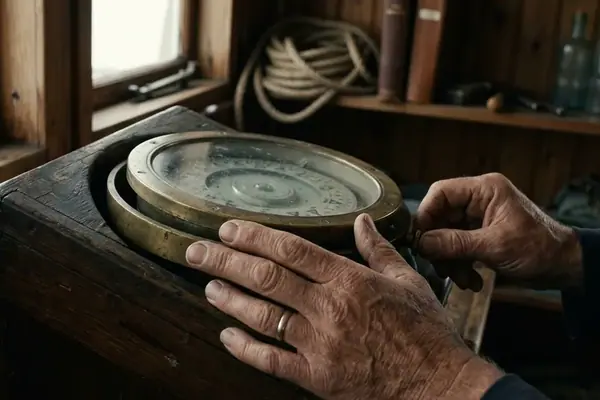
Slocum assigned his primary timepiece a purchase price of $1.50. His published narrative does not supply the sort of maker, serial number, rate certificate, or temperature record expected for a marine chronometer. The clock accompanied a voyage extending from April 1895 to June 1898. During this time, its lost hand, stoppage, and an improvised boiling treatment prevented any defensible calculation of a stable daily rate.
Note: The tin clock's stoppage and unstable condition represent a failure case, not proof that defective timepieces improve navigation. Slocum survived the equipment failure strictly because he possessed independent methods to verify his position.
Solution Part I: Dead Reckoning as a Sensory Science
A dead-reckoned position is advanced from the previous fix by recording heading, estimated speed, elapsed time, and allowances for current and leeway. On the Spray, those inputs depended on repeated sensory comparisons. A practical ocean log was advanced whenever the course, sail plan, wind strength, or estimated speed changed. The navigator then reconciled these entries over the roughly 24-hour interval between successive local-noon observations.
An unnoticed speed error of 1 knot sustained for a 12-hour watch displaces the dead-reckoned position by 12 nautical miles before current or leeway is added. Maintaining an accurate log over thousands of miles without external verification relies entirely on internal calibration. The sailor must read the ocean's surface, feel the helm, and observe the wake to estimate speed and leeway continuously.
Solution Part II: Mastering Lunar Distances
When the tin clock failed to provide reliable Greenwich time, the lunar distance method offered an independent solution. The navigator first measured the angular distance from the Moon's illuminated limb to the Sun, a star, or a planet with a sextant. The observer also obtained the altitudes needed for reduction. Late-19th-century lunar-distance tables supplied predicted distances at three-hour Greenwich intervals, requiring interpolation between tabulated values after the observed angle had been cleared.
One catch: a usable lunar requires a visible Moon and comparison body, adequate horizon or altitude data, a readable almanac, a calibrated sextant, and enough stability to repeat the contact; prolonged cloud or a poorly defined lunar limb can remove the method precisely when an independent fix is most wanted.
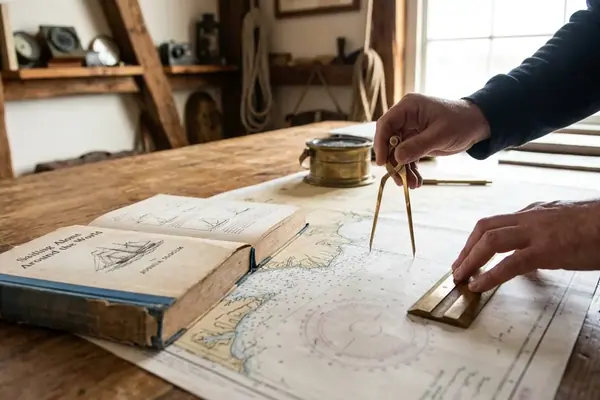
On the 72-day Pacific passage from Juan Fernandez to the Marquesas in 1896, Slocum reported that a lunar result agreed with his dead reckoning to within five miles. This reported agreement comes directly from his memoir, Sailing Alone Around the World, rather than an independently preserved observation worksheet. Consequently, it should not be converted into a general accuracy rating for all of his dead-reckoned or lunar positions.
The Results of Traditional Seamanship
Navigational results are judged by identifiable landfalls and by reported agreement between independent methods, not by assuming that every plotted position was equally accurate. The Spray's completed route included constrained or comparatively small targets such as the Strait of Magellan approaches, the Marquesas, Samoa, Torres Strait, the Cocos Islands, and the approaches around the Cape of Good Hope before the Atlantic return. Hitting these marks required relentless discipline.
Historical analysis of the society archives confirms that the celebrated $1.50 expenditure describes the tin clock alone and excludes the sextant, nautical almanac, charts, compass, log gear, and decades of professional sea experience that made the navigation possible.