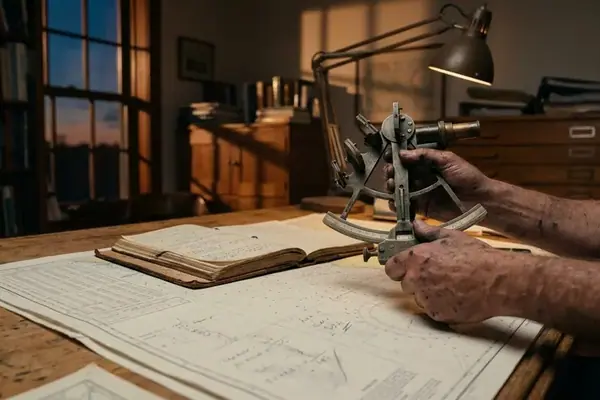
Single-Handed Circumnavigation and the Pidgeon Baseline
A true single-handed global circumnavigation is defined by who sails the vessel across the oceans, even when the voyage includes intermediate port calls, ashore repairs, and harbor hospitality. To complete a global circuit, a lone mariner must sail around the world, cross all meridians of longitude, and return to the original point of departure. Within the Solo Circumnavigators Registry and our broader society archives, we distinguish between a nonstop voyage and a circumnavigation broken by harbor stays, yet both test the fundamental relationship between a solitary sailor and a capable vessel.
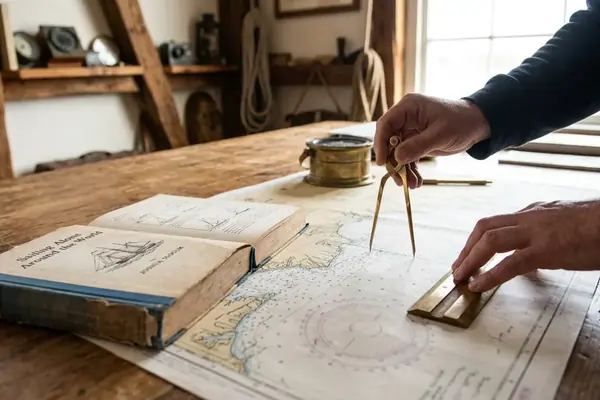
Captain Joshua Slocum set the inaugural standard between 1895 and 1898 aboard The Spray, immortalized in his classic memoir Sailing Alone Around the World. Yet Slocum stepped aboard his rebuilt oyster sloop at the apex of a lifelong career as a professional merchant captain, shipmaster, and commercial navigator. He knew the southern oceans, the set of ocean currents, and the feel of a wooden hull under storm canvas long before he cast off alone from Boston.
Harry Pidgeon entered the historical record from an entirely different vantage point. Leaving Los Angeles Harbor on November 18, 1921, and returning to the same port on October 31, 1925, Pidgeon became the second person in recorded history to sail single-handed around the world. His 1932 memoir, Around the World Single-Handed, documents a voyage that serves as the true baseline for the amateur blue-water cruising movement.
Born on an Iowa farm and working as a ranch hand, fruit grower, and traveling photographer in Alaska and the American West, Pidgeon possessed zero commercial shipyard experience and no professional maritime credentials. He learned how to frame a boat and reduce a noon sight by reading public library books and boating magazines. When working sailors and modern short-handed voyagers study Pidgeon, they encounter a practical blueprint: a man of modest capital who built his own vessel on a municipal beach, taught himself celestial navigation on his outward leg to Hawaii, and proved that global ocean voyaging belonged to disciplined amateurs as much as to master mariners.
Why an Amateur Chose the Rudder Seagoer V-Bottom Yawl Design
Before Pidgeon could cross an ocean, he had to solve a severe problem of labor and capital. Lacking the funds to commission a commercial yacht yard and lacking the shipwright skills required to loft and steam-bend the compound curves of a traditional round-bilged hull like The Spray, Pidgeon needed an offshore design that one pair of hands could assemble with basic carpentry tools.
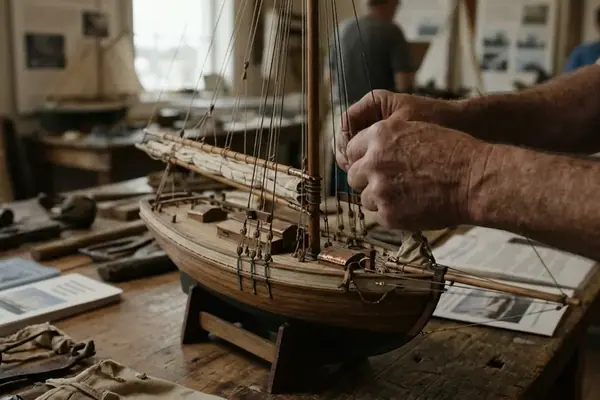
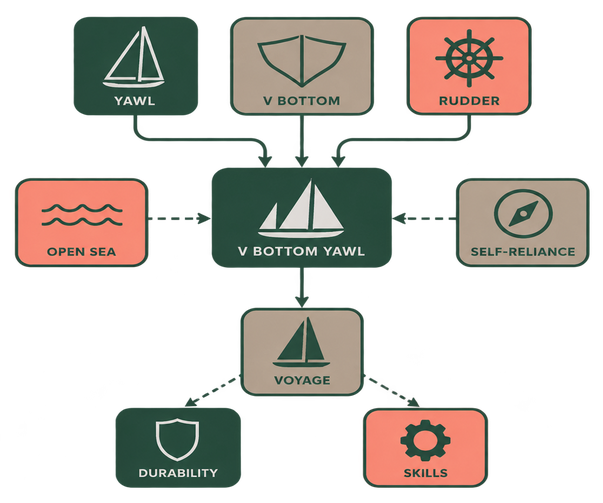
He found his answer in the pages of The Rudder magazine, edited by the influential small-boat advocate Thomas Fleming Day. Pidgeon selected the magazine's published "Seagoer" plans—a hard-chine, V-bottom yawl specifically conceived for amateur backyard construction. Working on the beach at Los Angeles Harbor between 1917 and 1919, Pidgeon spent roughly 18 months building the vessel he christened Islander.
Structural Logic of the Chine Hull
The architectural brilliance of the Seagoer design for a solo builder lay in its cross-sectional geometry. A round-bilged vessel requires heating heavy oak ribs in a steam box and forcing them into curved molds while beveling every plank along shifting curves. By contrast, a V-bottom (or deadrise) hull breaks the underwater shape into flat planes meeting at a sharp chine log. This geometry allowed Pidgeon to saw straight frames and run heavy Douglas fir planking along predictable, straightforward lines without wrestling complex compound curves alone on the sand.
- Length Overall: 34 feet, 11 inches, providing adequate waterline length for ocean tracking while keeping timber lengths manageable for one person.
- Beam: 10 feet, 9 inches, lending high initial form stability to carry working canvas in trade-wind squalls.
- Draft: Approximately 5 feet, deep enough to provide lateral resistance upwind while permitting entry into shallow island lagoons and drying careening beaches.
- Rig Configuration: A divided yawl plan carrying a headsail, a manageable mainsail, and a small mizzen stepped aft of the rudder post.
While later secondary summaries occasionally quote specific sail-area totals such as 630 square feet, archival discipline requires checking exact spar dimensions against the original Rudder sail plan before treating single figures as definitive. What mattered on deck was how that divided yawl rig split the total canvas into three smaller sails. When a squall built on the horizon, Pidgeon could drop the mainsail entirely and keep Islander moving under jib and mizzen alone, never having to fight an oversized boom across the deck in heavy seas.
Mastering the Sextant and Chronometer Without Sea Trials
With Islander launched and provisioned, Pidgeon faced his next major hurdle: finding a tiny volcanic archipelago in the middle of the Pacific Ocean using book-learned mathematics. When he cast off from Los Angeles on November 18, 1921, bound for Honolulu, he stepped into an offshore classroom without prior deep-water sea trials.
His navigation station held no luxury instruments. Pidgeon carried a basic sextant, nautical almanac tables, a boat compass, a taffrail rotor log streamed astern to measure distance run through the water, and watches to keep track of Greenwich time. Every ocean navigator works inside the tension between two positions: the estimated dead-reckoning position advanced by compass course and log distance, and the calculated position derived from celestial bodies.
The 42-Day Shakedown to Hawaii
Pidgeon used his 42-day outward passage to Honolulu as a live proving ground to unite theory with rolling decks. Celestial sight reduction at sea divides into two distinct operations that often blur together in casual voyage retellings:
- Meridian Altitude for Latitude: Watching the sun climb to its zenith at local apparent noon required patience at the sextant, yielding a direct calculation of north-south position without relying on an exact second of time.
- Timed Sights for Longitude: Shooting the sun in the morning or afternoon demanded pairing the measured altitude above a tossing horizon with an exact time reference from his watches, then working through sight-reduction tables to establish east-west lines of position.
Between clear horizons, Pidgeon tracked his dead reckoning by reading the taffrail log and estimating leeway—the sideways drift of the V-bottom hull pushed by wind and wave. Whenever a fresh celestial fix diverged from his dead-reckoning plot, the gap revealed the combined influence of ocean current, steering yaw, and compass deviation. Confirming historical logbooks and published tracks, the 42-day Hawaii passage establishes a completed first ocean leg, though the surviving narrative record does not preserve daily sextant observations from which a numerical error range could be reconstructed. Pidgeon reached Honolulu safely, proving that a careful reader could master the sextant while already out of sight of land.
Trade-Wind Routing and Sheet-to-Tiller Balance Across the Southern Oceans
Once secure in his navigation and vessel handling, Pidgeon confronted the strategic geometry of a westward circumnavigation. Twenty-six years earlier, Captain Joshua Slocum had driven The Spray south into the fierce, freezing gales and labyrinthine channels of the Strait of Magellan. By 1921, however, global maritime geography had changed permanently.
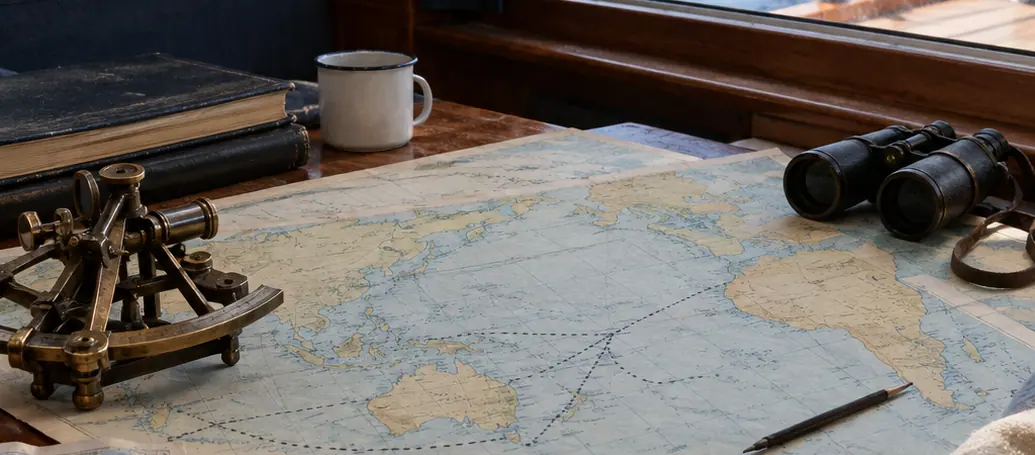
The Panama Canal had opened to shipping in 1914, seven years prior to Pidgeon's departure. Pidgeon shaped a warm-water trade-wind course that linked the South Pacific islands to Australia's Torres Strait, crossed the Indian Ocean toward the southern tip of Africa, angled northwest up the South Atlantic, and transited the Panama Canal back into the Pacific. This route traded the high-latitude survival storms of Cape Horn and Magellan for long, rolling down-wind and broad-reaching runs through the tropical and subtropical belts.
Aerodynamic Balance Versus Mechanical Linkage
Sailing thousands of miles across the trades without an auxiliary engine or a mechanical servo-pendulum windvane forced Pidgeon to rely on the physics of hull and sail trim. In modern sailing discussions, three distinct self-steering arrangements are frequently conflated: a lashed tiller, pure aerodynamic sail balance, and a mechanical sheet-to-tiller feedback line. Pidgeon's success rested primarily on the inherent balance between Islander's divided yawl rig and her underwater lateral plane.
On a yawl, the small mizzen sail perched aft of the rudder acts as an aerodynamic lever. When Pidgeon trimmed the jib forward, eased or reefed the mainsail amidships, and sheeted the mizzen flat aft, he aligned the center of effort of the sails with the center of lateral resistance of the hull. If a wave knocked the bow off the wind, the flat mizzen caught more breeze at a wider angle and pushed the stern back down, bringing the bow back up toward the course. If the boat rounded up slightly, the headsail paid the bow off.
Yawl Balance Trial Checklist
Short-handed sailors can test the natural directional balance of a split rig or sloop using this daylight sea-trial protocol inspired by Islander's ocean routines:
- Conduct the exercise in daylight, in open water, with a dedicated lookout and a crew member immediately available to take the helm.
- Begin with appropriate working sail and normal fore-and-aft vessel loading; record wind direction, approximate sea state, and initial point of sail.
- Adjust headsail, mainsail, and (if fitted) mizzen trim incrementally until helm pressure at the tiller or wheel approaches neutral.
- Release or lightly restrain the helm briefly and observe whether the vessel rounds up into the wind, falls off, or holds a narrow heading band.
- Test a reefed or reduced-main combination to see how moving aerodynamic drive forward or aft alters the boat's self-correcting behavior.
- Practice heaving-to under reduced canvas and record the drift rate, bow angle to the seas, and motion comfort below decks.
This natural helm balance had strict operational boundaries. Islander held a steady unattended track primarily when reaching or running in consistent trade winds. When entering the variable squalls of the doldrums, beating against shifting coastal breezes, or threading coral passes in the South Pacific, aerodynamic balance broke down. During those transitions, Pidgeon had to hand-steer for long watches or heave the vessel to while he slept, waiting for steady wind to return.
The False Bay Grounding and Improvised Salvage on the African Coast
Even the best-balanced yawl cannot protect a solo sailor from the cumulative toll of sleep deprivation near a lee shore. After crossing the Indian Ocean and rounding the southern tip of Africa, Pidgeon suffered the defining crisis of his four-year voyage: exhaustion overtook him near the South African coast, and Islander ran hard ashore through the surf.
Charting the African Grounding
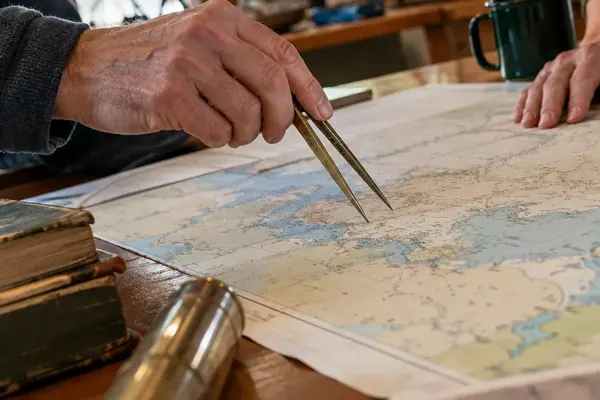
Secondary summaries of Pidgeon's wreck frequently splice two incompatible South African locations together, describing a grounding in "False Bay, northwest of Cape Town near Paternoster." Any maritime scholar looking at an Admiralty chart will spot the contradiction immediately: False Bay lies east and south of the Cape Peninsula, whereas Paternoster sits roughly eighty miles north of Cape Town on the cold Atlantic coast.
Tracing Pidgeon's actual northward track after clearing the Cape Peninsula resolves the geographical confusion. Having already rounded the Cape of Good Hope and departed Cape Town bound toward St. Helena in the South Atlantic, Pidgeon was working northward along the western Atlantic coast of South Africa when fatigue overcame him near the fishing settlement of Paternoster, northwest of Hoedjes Bay. Readers consulting archival holdings, such as the Library of Congress maritime history archives or original editions of Around the World Single-Handed, should keep those two coastlines strictly separate rather than blending them into a single composite narrative.
Why the Home-Built Hull Survived the Surf
When a cruising yacht drives onto an open beach through breaking ocean swell, the hull experiences violent hogging and pounding loads along its keel and bilges. Many lightly framed yachts break their backs within hours as the tide recedes and leaves the hull unsupported.
Here, Pidgeon's rugged amateur construction paid off completely. Because he had framed and planked Islander with heavy timber scantlings intended for simplicity and strength rather than racing lightness, the V-bottom hull absorbed the initial surf impacts without stove-in planks or popped garboard seams. The flat deadrise panels allowed the boat to settle on the sand without rolling completely over onto her deck beams.
Once stranded, Pidgeon faced the daunting physical task of recovering a heavy wooden cruising boat without commercial salvage tugs on station. In maritime terminology, historical writers sometimes misuse technical recovery terms when describing this episode:
- Stranding vs. Careening: Lying grounded on a surf beach by accident is a stranding; careening refers specifically to the deliberate heeling of a vessel on a sheltered tidal flat to scrub, caulk, or inspect the underwater planking and false keel.
- Lightening and Refloating: Getting a stranded hull off the sand requires reducing draft by offloading heavy internal stores and movable ballast, protecting the hull from surf broaching, and hauling her back across the bar into deep water with local shore assistance when the tide serves.
While general secondary accounts lack the granular daily salvage log needed to verify exact poundages of removed ballast or every anchor line laid out during the Paternoster recovery, the structural outcome stands beyond dispute. Refloated, inspected, and refitted after her ordeal on the African sand, Islander remained structurally sound enough to cross the South Atlantic, transit the Caribbean, and sail all the way home to California.
Applying the Pidgeon Blueprint to Modern Short-Handed Voyaging
When Harry Pidgeon dropped anchor back in Los Angeles Harbor on October 31, 1925, just under four years after his departure, he had altered the course of small-boat history. The Cruising Club of America recognized his achievement by awarding him the Blue Water Medal for 1925—making this self-taught Iowa farm boy and amateur boatbuilder the first American recipient of the prestigious offshore honor.
Looking closely at his four-year timeline reveals a vital lesson about human endurance. Pidgeon's elapsed voyage duration included generous, unhurried stays in island harbors and colonial ports. Unlike modern racing sailors who view port time as a failure of scheduling, Pidgeon treated prolonged harbor intervals as essential maintenance periods for both ship and skipper. While we cannot extract a quantified medical formula for fatigue reduction from his logbook dates alone, his willingness to linger ashore until his sails were stitched, his timber hull was painted, and his body was rested kept him sharp across three oceans.
The Pidgeon Offshore Principles
- Build and Maintain What You Understand: Choose hull materials and mechanical systems that a lone sailor can inspect and repair on a remote beach with hand tools.
- Divide the Sail Plan: Keep individual sail areas small enough that reefing, dousing, or balancing the rig never exceeds the physical strength of one tired person on a pitching deck.
- Respect Harbor Recovery: Treat extended port stays as deliberate operational resets rather than delays in a rigid schedule.
Modern short-handed sailors preparing for ocean passages often approach their refit budgets backward, pouring tens of thousands of dollars into dual linear-drive electronic autopilots, high-output lithium battery banks, and complex hydro-generators to keep a poorly balanced sloop on course. Stand behind the lesson of Islander instead: before wiring a single electronic autopilot brain or mounting an auxiliary charging array for an offshore refit, take your vessel out into open water and configure her sail plan, mast rake, and reefing points until she can steer herself on a reach and heave-to stably without drawing a single amp of battery power.