Thirty-Six Feet of Oak and Pasture-Bent Timber
Joshua Slocum recorded Spray as 36 feet 9 inches long overall, 14 feet 2 inches in beam, and 4 feet 2 inches deep in the hold. These measurements establish the starting point for understanding the oyster sloop he rebuilt at Fairhaven, Massachusetts, during 1892–1893.
Length overall measures the hull from end to end. Beam records its breadth. Depth in the hold describes an internal dimension: it must remain separate from draft, which concerns the hull’s immersion. Substituting the hold measurement for draft would give a misleading picture of the underwater vessel.
Consider a reconstructed boarding scene aboard a faithful replica. A sailor steps onto the deck expecting the proportions of a modern cruising yacht and encounters something closer in breadth to a working barge. The beam exceeds one-third of the overall length. That breadth belongs to the oyster boat’s working requirements: space for handling loads, carrying them, and moving around them.
Slocum’s Sailing Alone Around the World supplies the historical foundation. The handling explanation requires a second step: following how hull shape, ballast, sails, and rudder act together. A polar diagram alone cannot explain why the vessel might keep moving steadily through a swell with little intervention at the wheel.
The useful question is how this broad working hull preserved motion and balance through an ocean passage.
How Extreme Beam and Heavy Displacement Dictate the Helm
Initial stability begins with the shape of the immersed hull. As a broad hull heels, its underwater volume changes shape and shifts buoyancy outward. That shift produces a righting moment. On a replica with comparable proportions, resistance to the first few degrees of heel can make the working deck feel reassuringly steady.
This helps explain the physical appeal for a lone sailor. Less immediate heeling can reduce the need to brace during ordinary deck work. It does not establish the vessel’s ultimate stability or a safe limit for carrying canvas.
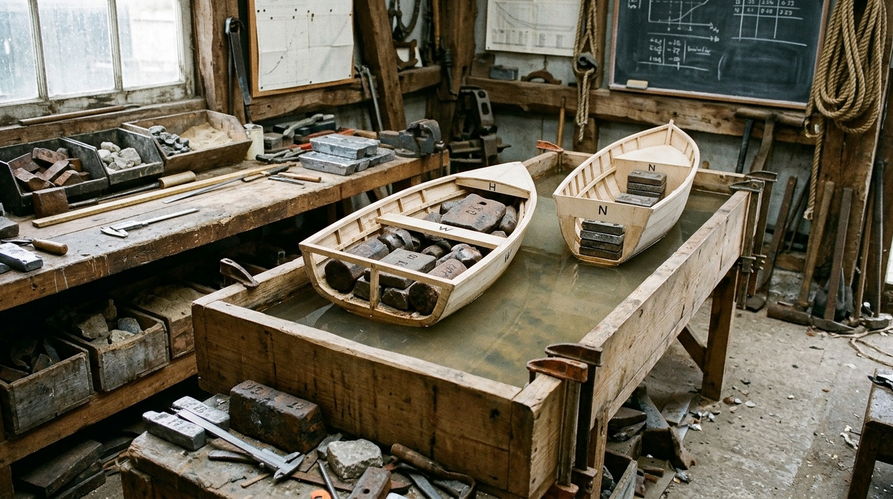
Ballast introduces a separate mechanism. Weight carried internally beneath the cabin sole contributes according to both its amount and its vertical position. An external ballast keel can concentrate weight substantially farther below the hull. Calling both vessels “heavy” conceals that important difference.
Momentum matters at the helm. In a head sea, successive impacts and pitching consume forward speed. Pinching closer to the wind can leave the sails drawing poorly just when the rudder needs useful water flow. Bearing away enough to restore drive helps preserve steering authority.
A comparison assembled from society archives should therefore record each replica’s ballast weight and position, mast positions, sail areas, and rudder configuration. A shared name or familiar silhouette cannot establish shared helm balance. Those particulars provide a sounder comparison than assigning every Spray replica the same ballast ratio.
Working the Long Keel Through a Tack
The oyster-sloop tack depends on a sequence: forward way, progressive rudder, timely headsail handling, and renewed drive after the bow crosses the wind. Each action prepares the next. In steep chop, losing speed before beginning the turn can make the whole maneuver laborious.
- Establish way. Bring the sails into useful draw. If the boat has been pinched too close to the wind, ease sheets slightly and bear away enough to regain speed before asking the bow to turn.
- Apply progressive helm. Begin the turn with enough rudder to develop rotation while preserving flow. An immediate demand for maximum angle adds drag and can stall flow over the rudder.
- Manage the jib through the wind. Coordinate its transfer with the bow’s movement and the vessel’s remaining momentum. If chop checks rotation, briefly backing the jib can help push the bow onto the intended tack.
- Regain speed. Once the bow crosses, allow the sails to draw on the new tack. Avoid hauling everything flat while the hull still needs to accelerate.
- Finish trimming. Settle onto the intended heading, then refine sheets and helm as the boat recovers her way.
Rudder Drag Costs Way
Excessive rudder angle can turn a slow tack into a stalled maneuver. It does not inevitably leave every long-keel vessel in irons, but it spends the forward motion on which steering depends.
The backed jib works because its force acts forward of the hull’s lateral resistance, helping turn the bow. Its timing matters more than forceful sheet handling. Once it has helped the turn, transferring and trimming it restores forward drive.
Lashing the Wheel: Why the Hull Tracks Without Windvanes
Slocum’s circumnavigation ran from 24 April 1895 to 27 June 1898. His published account describes extended passages with the helm secured. The distinction between that account and a mechanical explanation deserves careful attention.
A wheel lashing fixes a selected rudder position. It supplies no independent correction signal comparable to a windvane. Course-holding instead depends on an equilibrium among sail forces, underwater resistance, and the fixed rudder angle.
The long keel resists rapid yaw. In evaluating a replica, the forefoot profile, including its degree of cutaway, belongs in the same examination as keel length and rudder configuration. Small differences in the underwater shape can change how readily the bow turns and how the hull responds to disturbed water.
Sail balance supplies the adjustments. Moving effort forward or aft changes the tendency to bear away or round up. The small after sail, commonly called the jigger, adds an aftermost adjustment and permits reduced-canvas combinations without relying on the large mainsail alone. Slocum’s conversion of Spray to a yawl is associated with Buenos Aires, Argentina.
For a replica trial, the sequence is to establish a reach, balance the headsail, mainsail, and jigger, then observe the heading through successive waves before securing the helm. The historical account supports examining this arrangement; it cannot guarantee the same result from another hull.
A dead run introduces a harder problem. Rolling and changing apparent wind can alternately empty and refill the sails. Confused following seas disturb an otherwise satisfactory balance. Reducing canvas and adjusting sheet leads may help; the leads alter the pull on each clew and therefore the sail’s shape.
The Rhythm of Rest That Kept the Captain Alive
For Captain Joshua Slocum, the value of manageable handling lay in conserving the strength of a single crew member. Fewer necessary steering interventions could leave more capacity for sail handling, navigation, meals, and rest during the 1895–1898 voyage.
A faster yacht could shorten a passage while demanding a different pattern of attention. Modern light-displacement hulls can also sail in balance. The useful comparison concerns the actual frequency of corrections and the effort needed to make them, rather than a blanket judgment about old and new designs.
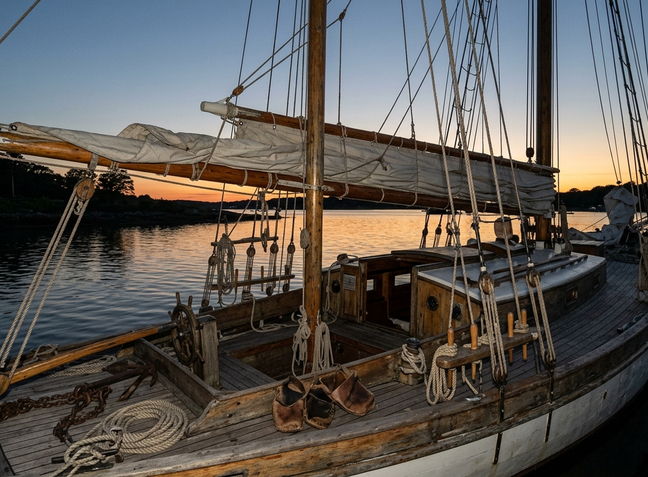
The following reconstructed moment brings the handling sequence together. At dusk aboard a 36-foot replica, a sailor eases the main peak halyard, changing the gaff’s angle and the sail’s shape. This adjustment does not reef the sail. A fresh quartering breeze fills the canvas. The sailor watches the heading through successive waves, then ties a simple lanyard around the wooden wheel spokes at the chosen setting. After checking the horizon, the sailor steps below and lights the cabin lamp. Above, the hull settles into a steady groove.