Command Does Not End at Shipwreck
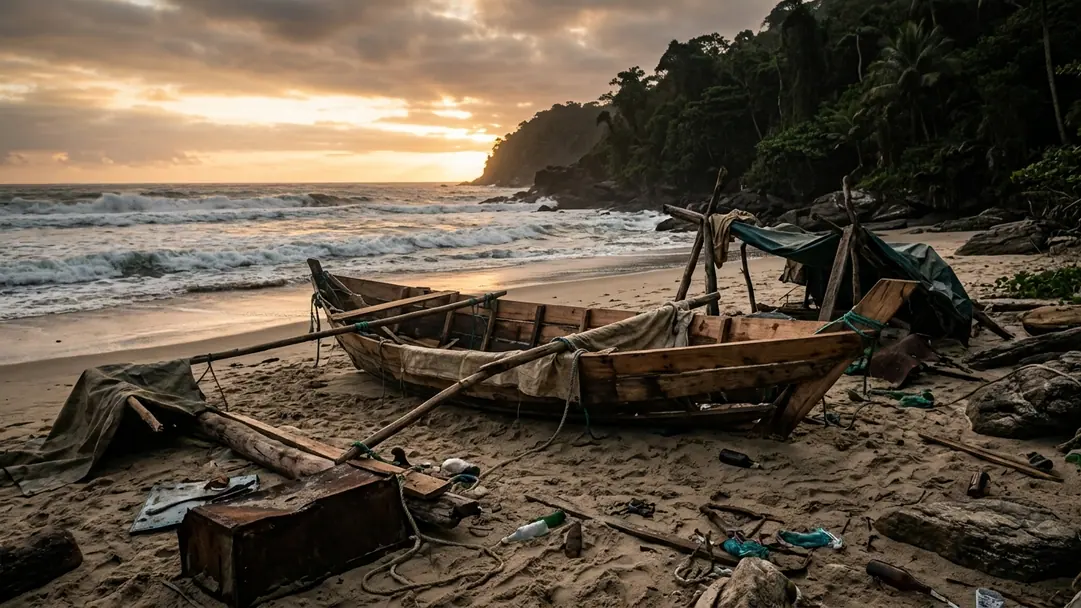
Shipwreck usually marks the point where a voyage ends and its survivors wait for outside help. Captain Joshua Slocum followed a different sequence after the merchant bark Aquidneck grounded in Guaraqueçaba Bay. He treated the stranded vessel as an inventory, assessed what remained usable, and redirected command toward building a way out.
The governing problem had changed. Preserving an ocean-trading bark required hull access, lifting power, skilled labor, replacement material, and a protected repair site. Those resources did not exist together on that part of the Brazilian coast. Slocum still had responsibility for his wife, children, provisions, navigation equipment, and any crew or stores remaining with the wreck.
His response produced one of the more instructive cases of improvised boatbuilding in nineteenth-century maritime history. The Aquidneck was lost in December 1887. The replacement vessel, Liberdade, entered the water on 13 May 1888. Within that interval, the stranded party assessed the bark, recovered useful material, prepared local timber, assembled a new hull, rigged it, and provisioned it for sea.
A wreck can remain a source of mobility after it has ceased to function as a ship.
This distinction matters. Slocum did not attempt to reproduce the lost bark at a smaller scale. He reduced the transport problem to its essentials: a hull capable of carrying several people, water, food, sails, and navigation instruments; a rig manageable by a small family crew; and a construction method suited to the ground and materials at hand.
The result measured approximately 35 feet overall, a radical reduction from a merchant vessel to a family-operated open-water craft. That reduction reveals the practical logic behind the project. Every foot of hull demanded timber, fastening, shaping, and maintenance. A shorter vessel lowered those demands while preserving the carrying capacity needed for a northbound passage.
The Wreck-to-Launch Boundary
The case can be read as a controlled transition with two firm dates. One is 18 December 1887, when Slocum’s narrative places the stranding. The second is 13 May 1888, when Liberdade was launched. Between those boundaries, command moved through three stages: abandoning recovery of the complete bark, converting wreck material into components, and testing a newly built vessel against an ocean route.
The Stranding of the Aquidneck in Guaraqueçaba Bay
The Aquidneck grounded on 18 December 1887 in Guaraqueçaba Bay, within the coastal waters of Paraná, Brazil. The decisive assessment concerned the condition of the ship as a whole rather than a single broken fitting. A grounded bark might retain sound timbers, rigging, and metalwork while still being beyond practical recovery as a transport system.
Any serious attempt to return such a vessel to service would have required coordinated access beneath and around the hull. Heavy lifting would have been needed to move or support it. Damaged structure would then have required replacement material, skilled hands, and a site where the work could proceed without repeated exposure to coastal conditions. Slocum could not assemble that repair chain at Guaraqueçaba.
The family’s presence sharpened the decision. A one-person emergency boat could have sacrificed endurance, storage, and shelter for speed of construction. Slocum’s replacement had to carry several people along with provisions, drinking water, sails, and navigation equipment. It also needed enough stability and sail control for family participation during a long passage.
From Ship Recovery to Family Mobility
The first tasks after the loss followed immediate human priorities: secure food and shelter, inspect the stores, and determine which parts of the stranded vessel could be removed safely. Once the bark no longer offered a credible route home, labor spent preserving it had diminishing value. Labor spent recovering finished components could shorten the construction of another craft.
This was also a psychological pivot. A merchant captain accustomed to commanding a substantial bark now had to plan around beach construction, limited supply, and a much smaller hull. The measure of success changed from restoring commercial carrying capacity to restoring independent movement.
That distinction kept the project disciplined. A replacement vessel did not need the cargo volume or deep structure of the Aquidneck. It needed enough seaworthiness, manageable sail area, and storage to advance along the coast and then through the longer northbound stages. Slocum defined the requirement around the people who would actually sail her.
The Irrecoverable Hull
A sound fitting could still have value even when the larger structure around it could no longer be saved. The assessment therefore separated the fate of the bark from the usefulness of its parts.
Salvaging Aquidneck for Liberdade’s Keel and Hull
Salvage began with a practical question: which objects already contained the greatest amount of skilled work? A copper fastening had been refined, formed, and proven in shipboard service. A block had already been shaped for running rigging. Canvas had already passed through a manufacturing process that could not be reproduced easily on a Brazilian beach.
These items deserved priority over raw material. Copper bolts and other fastenings from the Aquidneck could be removed, cut down, and worked for a hull only 35 feet long. That gave Liberdade ship-grade metal without requiring a foundry or an ordinary chandlery supply chain.
Usable cordage, canvas, blocks, fittings, and rigging carried the same advantage. Each recovered component eliminated a specialized purchase or fabrication step. Selected structural members also retained value, particularly where sound timber or a useful curve could be incorporated into the smaller vessel.
The Copper-to-Fastening Sequence
- Inspect the wreck. Separate sound metal and fittings from pieces distorted or weakened beyond further use.
- Recover finished material. Remove copper, cordage, canvas, blocks, and selected timbers while access to the stranded bark remains possible.
- Resize for the new hull. Rework fastenings originally intended for a merchant bark so they suit the lighter scantlings of a 35-foot craft.
- Assign by structural need. Reserve the most dependable material for joints and hull connections where replacement at sea would be difficult.
- Supplement locally. Use Brazilian woods for the long planking, framing, and other major hull elements that the wreck could not supply in suitable form.
Native timber completed the material plan. Local Brazilian woods supplied much of the new hull, while the wreck contributed reusable copper, canvas, cordage, fittings, and selected structural members. The boat therefore combined two distinct resources: locally available raw wood and highly processed maritime material recovered from the Aquidneck.
| Operational problem | Decision | Physical evidence | Result |
|---|---|---|---|
| A grounded merchant bark without a practical local repair chain | Stop allocating labor to recovery of the complete ship | The December 1887 wreck remained available as a source of components | Effort shifted to a smaller replacement craft |
| Limited access to manufactured ship supplies | Recover material with finished work already embodied in it | Copper, canvas, cordage, blocks, fittings, and selected timbers | Specialized fabrication and purchasing needs were reduced |
| Insufficient wreck timber for an entire new hull | Combine salvage with native Brazilian woods | Local wood supplied major hull material | A complete 35-foot vessel could be assembled |
| A family passage rather than a one-person escape | Provide carrying capacity and divided sail handling | A broad hull and three-masted rig | People, provisions, water, sails, and instruments could travel together |
The construction sequence ran from the wreck in December 1887 to the launch on 13 May 1888. It included salvage, timber preparation, hull assembly, rigging, and provisioning. Viewed as a work schedule, the achievement rested less on haste than on careful allocation: preserve finished material, obtain long structural pieces locally, and avoid features that demanded unavailable shipyard equipment.
Designing Liberdade on a Brazilian Beach
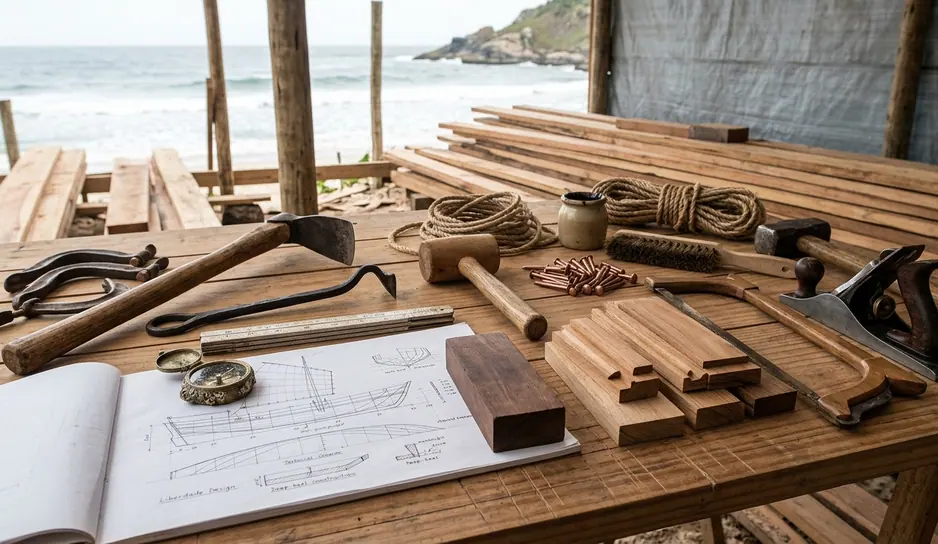
Liberdade combined the straightforward bottom and sections associated with a Cape Ann dory with features Slocum identified from Japanese sampans. Contemporary descriptions give the vessel as about 35 feet overall, roughly 32 feet on the waterline, 7 feet 6 inches in beam, and close to 3 feet in depth.
Those dimensions describe a compact but capacious family boat. The broad, comparatively flat dory-like bottom reduced the need for deep-keel construction and elaborate moulding. It also suited work carried out on an exposed shore, where a builder could not rely on the lifting arrangements, prepared stocks, or enclosed working floor of a shipyard.
Sampan-like features contributed fuller ends and useful carrying volume. Slocum had to reconcile several competing requirements: shallow construction, offshore steadiness, room for stores, and a hull light enough to complete with the labor and material available. The hybrid form addressed the complete set rather than copying one established boat type.
Why Three Short Masts Mattered
The rig divided the working sail area among three masts with battened lug or junk-style sails. This distribution kept the crew from depending on one large mainsail. Individual sails could be handled in smaller units, and their balance could be adjusted as loading and conditions changed.
The battens helped control the shape and handling of each sail. For a family crew aboard a 35-foot vessel, this arrangement placed a premium on manageable operations. Sail could be reduced or shifted without requiring the physical effort associated with a single dominant spread of canvas.
Hull and rig therefore answered the same constraint. The hull simplified construction; the three-part sail plan simplified handling. Both drew on forms Slocum knew from different maritime traditions. His contribution lay in selecting the useful features and fitting them to a specific beach, crew, and route.
Reading the Reported Dimensions
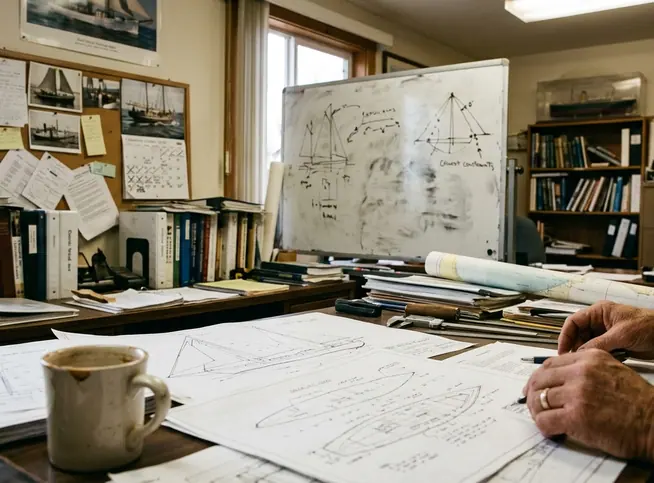
The measurements permit a proportional reading of the vessel, though they do not provide a complete construction plan. A waterline near 32 feet within an overall length of about 35 feet indicates that most of the hull contributed to carrying and displacement. The reported beam of 7 feet 6 inches supplied breadth for a loaded family craft, while the depth of about 3 feet kept the structure compact.
These are historical reported measures, not GPS mileage or a surviving modern lines survey. The responsible reconstruction therefore emphasizes documented proportions, bottom form, and rig arrangement without inventing missing offsets.
Navigating 5,500 Miles in a 35-Foot Canoe
The launch on 13 May 1888 opened the next phase of the experiment. Slocum did not begin with a single blind leap across open water. He used the Brazilian coast as a staged sea trial, observing trim, steering, leakage, sail balance, and the family’s ability to operate the three-sail rig.
This sequence allowed correction through use. Provisions and water affected trim. The interaction among three sails affected steering pressure. A new hull also had to show whether its seams and fastenings would remain dependable after repeated working in coastal water. Each leg converted a beach-built object into a tested vessel.
From Coastal Trial to Northbound Passage
- Launch and load. Place family, stores, sails, water, and navigation equipment aboard while retaining workable trim.
- Observe near the coast. Test steering response, leakage, and sail balance where shorter route stages remain possible.
- Adjust the distributed rig. Use the three sails to balance the boat rather than asking one large sail to provide most of the drive.
- Commit to longer legs. Extend the voyage as hull, rig, and crew demonstrate that they can sustain offshore work.
- Continue through staged calls. Carry the same assessment process through the Caribbean and toward the United States.
The name Liberdade, Portuguese for liberty, took its significance from the launch date, when Brazil’s abolition law was celebrated. The name joined a public event to the family’s regained mobility. A vessel assembled from a wreck had become the means by which its builders could leave under their own sail.
Slocum reported roughly 5,500 miles for the voyage from Brazil toward the United States. His chronology places the passage from the 13 May launch to arrival at Barbados on 7 July 1888, a 55-day northbound phase before the later Caribbean and United States legs.
The performance evidence lies in continuity. A shallow hybrid hull carried its load through coastal waters and offshore passages. The distributed sail plan remained workable for the small crew. Beyond Barbados the vessel continued through later route stages rather than ending its service after the first major landfall.
Liberdade offered a demanding proof of concept because the voyage tested construction, carrying capacity, handling, and endurance together. The reported 5,500 miles cannot isolate the value of any one design feature. They do establish that the combined system remained navigable far beyond a local escape passage.
How Liberdade Reached the Smithsonian
The evidentiary chain gives Liberdade a place beyond maritime folklore. The Aquidneck was lost on a named date. A bounded construction period followed. The replacement vessel had recorded dimensions and identifiable design influences. Its route included dated stages, and its journey ended in Washington, D.C.
Slocum published Voyage of the Liberdade in 1890, creating a near-contemporary account of the wreck, construction choices, route, and family passage. Readers can examine the historical accounts of the Liberdade’s construction and voyage alongside catalog descriptions and the known chronology.
Academic Sources
Source verification should begin with the sequence rather than an isolated anecdote. The principal checkpoints are the 18 December 1887 stranding, recovery of material from the Aquidneck, use of Brazilian timber, the 13 May 1888 launch, the Barbados date of 7 July, the later passage toward the United States, and the vessel’s public exhibition in Washington.
This method also separates direct evidence from later interpretation. Slocum’s 1890 publication supplies a close narrative source. Reported dimensions describe the vessel’s general form. The United States National Museum’s exhibition of the craft supplies institutional continuity between the beach-built boat and its later public history within the Smithsonian Institution.
What the Voyage Leaves for Sailors
The practical lesson begins with inventory discipline. After severe hull loss, useful material should be ranked by condition, the skilled work already contained in it, and the difficulty of replacing it. Slocum’s copper fastenings mattered because they could be adapted without a foundry. Cordage, canvas, and blocks mattered because each item removed a specialized manufacturing problem.
The second lesson concerns scale. Slocum restored mobility with a craft proportioned to the available labor, construction ground, and crew. The modest hull and divided rig kept the project within reach while preserving the ability to carry a family and ocean provisions.
The final lesson is recorded in the vessel itself. A boat begun after the December 1887 wreck entered the water on 13 May 1888, sailed a reported 5,500 miles, reached Washington, D.C., and entered public view at the Smithsonian Institution’s United States National Museum: an ocean voyager only 35 feet long, built from wreckage and Brazilian timber.