Pay a first-edition premium for a later Century Co. trade issue and you lose the entire financial distinction that justified the price. Conversely, an estate browser who mistakes a rare, unusual primary binding for a crude period replacement leaves serious money on the table. When Captain Joshua Slocum sailed the Spray into Newport, Rhode Island, on 27 June 1898—completing the single-handed voyage he had begun from Boston on 24 April 1895—his shipboard log was about to become an enduring literary landmark. Today, collectors who track the Solo Circumnavigators Registry and build maritime libraries treat that 1900 physical book as the cornerstone of blue-water literature.
Financial Risks in Turn-of-the-Century Printings
Separating a true 1900 first edition from a later reprint requires disciplined physical inspection before any price is discussed. Before making an offer on a turn-of-the-century copy of Sailing Alone Around the World, demand unedited photographs of the title page, the copyright verso, both exterior boards, the spine, and all three text-block edges.
A systematic buyer records the exact publication date, copyright statement, pagination, illustration sequence, cloth hue, stamping pigments, and top-edge treatment, then compares those notes against an institutional record or verified items in the society archives. For a realistic present-day valuation, assemble documented auction and dealer sales from 2023–2025 and sort them into three strict comparison groups: unsigned trade copies, authenticated presentation copies, and restored or rebacked examples. Blurring those categories guarantees an overpayment.
Verify Before You Bid
The xvi-plus-294 collation, Spray architectural plans, and globe-stamped cloth must be checked as three separate parts of the same 1900 book. Never rely on the front cover alone to authenticate the text block inside.
The 1899 Century Magazine Serialization
Before the narrative ever appeared between hard boards, it captured a national readership in serial form. Collectors often encounter these early chapters without realizing how the periodical format dictates value and completeness.
The narrative first ran across seven monthly issues of The Century Illustrated Monthly Magazine, beginning in September 1899 and concluding in March 1900. Because the publisher bound its year into semiannual books, a complete run of Slocum's text crosses two distinct volumes: Volume LVIII (covering May through October 1899, which holds the September and October chapters) and Volume LIX (covering November 1899 through April 1900, containing the remaining five installments). You cannot house the first serialization in a single bound spine.
Loose Monthly Wrappers Versus Bound Volumes
How you evaluate these appearances depends entirely on their state of preservation:
- Original Monthly Paper Wrappers: Loose issues preserve the magazine's separate-issue identity, period advertisements, and surrounding historical articles. When grading loose issues, record the presence and condition of the paper wrappers separately from the completeness of the Slocum installment inside.
- Publisher-Bound Semiannual Volumes: These hardcovers gather the editorial contents into a durable shelf format, frequently stripping away the original paper wrappers and advertising leaves in the bindery.
- Layout and Sequence Differences: The magazine's multi-column layout places artwork within a reading sequence that differs noticeably from the 1900 book's single-column pages. A displaced drawing in the magazine is a feature of periodical typesetting, rather than automatic evidence of a textual revision.
Authenticating the 1900 Century Co. Hardcover
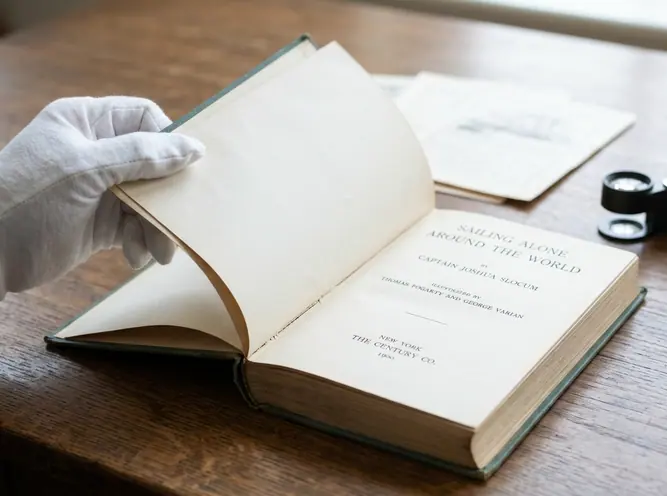
When inspecting the book itself, start at the title leaf and work outward to the cloth. A complete-looking title page can still conceal a sophisticated repair or a married text block if you skip the page-by-page count.
First, transcribe the New York publisher's imprint (The Century Co.), confirm the 1900 publication date on the title page, and inspect the reverse for the exact copyright wording and the De Vinne Press printer's mark in their expected positions. Check both sides of every preliminary leaf closely; a clever paper repair at the inner gutter can hide a replacement title leaf swapped in from a damaged copy.
Physical Collation and Binding Checkpoints
- Verify the Exact Page Count: Collate the book against the Library of Congress bibliographic record for Sailing Alone Around the World (1900). The standard 1900 first edition contains exactly xvi preliminary pages followed by 294 numbered pages of text.
- Inspect Gatherings and Sewing: Conduct a gathering-by-gathering inspection from front to back. Record signature marks where visible, check for disturbed thread in the gutter, and follow the sewing structure to distinguish an intentionally unprinted blank leaf within a gathering from a torn-out page.
- Examine the Pictorial Cloth: The primary publisher's binding features blue-green cloth stamped on the front board with the globe and the sloop Spray. Look for three distinct stamping mediums: bright gilt, pale white pigment, and dark green detail.
- Confirm the Top Edge Gilt (TEG): Inspect the top of the text block for the factory gilt finish. Compare the wear and patina of that top gilt against the uncut or plain fore-edge, the lower edge, and the overall board wear to ensure the edges have not been trimmed or regilded by a modern binder.
Inspecting the Fogarty and Varian Plates
Visual documentation forms the heart of the 1900 production. Thomas Fogarty and George Varian executed the line drawings and half-tone illustrations that bring the Spray and her landfalls to life, and their presswork offers critical clues during an authentication.
Open to the book's illustration list and use it as your sequential checklist. Begin at the opening of the volume by verifying the frontispiece, checking its attachment at the inner gutter, and looking for faint offset ink on the facing tissue or title leaf. As you turn through the text, distinguish illustrations printed directly within the text gatherings from separately inserted plate leaves before declaring any artwork missing. Pay special attention to the architectural plans showing the arrangement and construction of the Spray; verify these technical drawings by their exact captions and their proper positions in the illustration sequence, rather than simply checking that a sketch of a sailboat appears somewhere in the book.
To assess impression quality, examine the fine standing rigging lines and dense shaded areas under diffuse raking light using 5× to 10× magnification. A loupe helps separate crisp, original printed dots and unbroken line work from surface dirt, paper abrasion, or modern pen retouching. While crisp impressions confirm clean presswork, neither a sharp illustration nor a cabin-like wear pattern establishes an early printing or ownership aboard Spray without bibliographical comparison or independent provenance.
Condition, Restoration, and Provenance
Turn-of-the-century books suffer predictable structural failures. Because the 1900 printing uses heavy coated paper stock to accommodate the half-tone illustrations, the text block pulls hard against its cloth case every time a reader opens the boards.
Always evaluate structure before cosmetic appearance. Support both boards in your hands, open the volume gently, and examine the front and rear inner hinges independently. One hinge may retain its intact original endpaper while the opposite joint exhibits cracked paper, exposed mull cloth, or loose play between the text block and the spine. On the exterior, record spine-gilt oxidation and dulling separately from the flaking of the fragile white stamping on the front cover.
Toning Versus Restoration
When grading paper and cloth, separate honest age from invasive repair. Describe uniform cream or light brown age toning separately from discrete foxing spots, dampstain tide lines, musty odors, or softened paper fibers caused by humid coastal storage. If a copy has visited a bindery, look for mismatched cloth grain at the joints, disturbed pastedowns, or an original spine strip laid down over fresh backing material. A conservation report or dealer description must state plainly whether a repair preserves the original spine cloth, replaces it entirely, or touches up worn cover stamping with fresh paint—each intervention alters market value differently.
Finally, look closely at the front endpapers for dated ink inscriptions from the captain's post-publication years between 1900 and 1909. The boundary between a worn Slocum memoir and a documented Spray-carried copy is an ownership record, not salt-colored staining. Captain Joshua Slocum routinely stowed stock copies of Sailing Alone Around the World aboard the Spray during his later coastal passages to sell and inscribe directly to dockside visitors, meaning any surviving copy bearing a dated harbor inscription naming a visitor or vessel stands as a physical relic sold straight across the deck of the famous sloop herself.