What Disappears When Slocum’s Original Papers Deteriorate
If an original document associated with Captain Joshua Slocum deteriorates after scanning, maritime historians lose evidence that the image cannot replace: the sheet’s manufacture, writing pressure, folds, repairs and traces of handling. A readable digital sentence can survive while the paper carrying it separates at the intersection of two historic folds.
Slocum’s solo circumnavigation aboard Spray ran from 24 April 1895 to 27 June 1898. Those dates establish the historical frame. They do not establish that a particular surviving sheet travelled aboard the vessel.
For the society archives, claims of long-standing stewardship should rest on dated accession entries and catalogue descriptions for correspondence and Solo Circumnavigators Registry records. The earliest verified entry provides the temporal anchor. Without that evidence, neither an institutional anniversary nor possession of a complete voyage log should be implied.
Volunteer-led storage faces a practical difficulty: a successful scanning session can make a fragile document seem finished. Yet acidic paper may continue weakening inside its folder. The response begins with a condition record identifying the accession number, document date, leaf count, folds, fragments and tears.
Record damage at fold intersections before opening correspondence again. That simple precaution gives the next handler a warning and makes later deterioration easier to detect.
Reading Pressure, Tide Lines and Watermarks in Maritime Paper
I begin with a distinction between what a sheet shows and what its history allows us to conclude. An indentation records pressure. A tide line records liquid movement. A watermark supplies evidence about paper manufacture. Each observation needs a separate place in the examination record.
For Slocum-era documents, examine the paper composition and condition rather than assuming uniform quality. Vulnerable wood-pulp paper, corrosive iron gall ink and suspected soluble salts present different problems. Iron gall deterioration may appear as brown halos, cracked strokes or missing paper where heavily inked areas have broken away.
A Folded Letter Under Three Kinds of Light
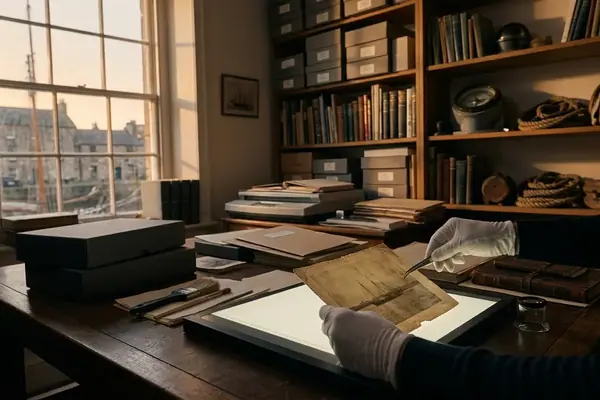
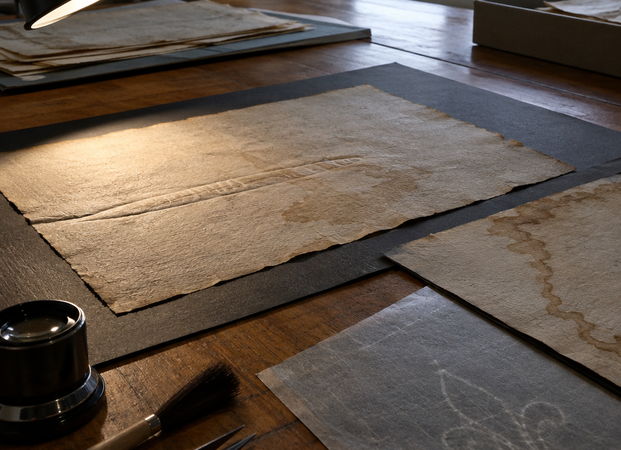
Consider a folded letter with a weakened crossing of creases. A transcribed PDF gives the editor’s reading of its words. Ordinary light shows the overall sheet and visible discoloration. Raking light, directed approximately 10–30 degrees above the surface, can reveal indentations, cockling and disrupted fibers. Transmitted light helps distinguish a watermark and paper structure.
Together, these views explain why the original needs support even when the transcription remains perfectly legible. They also preserve questions that a flat image may leave unresolved: does a stroke cross damaged fibers, or does the damage interrupt the stroke?
The Magellan Boundary
Neither pen pressure nor a water stain independently establishes heavy weather aboard Spray or a deck leak in the Strait of Magellan. Those interpretations require corroborating dated text and provenance. A brown tide line alone does not identify sea salt.
Keeping Slocum Scans Readable Requires Continuing Custody
A remote researcher needs readable words and a reliable catalogue reference. The archive also needs an original whose identity, condition and location remain traceable. Digital access and physical preservation therefore require linked, continuing work.
The society’s catalogue can expose descriptions and available surrogates to researchers studying Sailing Alone Around the World and its documentary context. Each surrogate should lead back to the original’s catalogue identifier. Before citing a letter from Gibraltar, Pernambuco or Apia, verify its date, place and repository against an actual record; a port on Slocum’s route proves no surviving correspondence.
A paper letter can survive a century while a digital copy becomes inaccessible through damaged media, changing formats or a lapsed storage service. Optical discs and cloud accounts both require maintenance decisions. Neither supplies a permanent archive merely by holding a file.
Separate Masters From Reading Copies
- Consider full-color capture at 400–600 pixels per inch at original size, recording a scale and color target during the session.
- Retain unaltered, lossless image masters separately from searchable PDFs and transcriptions.
- Record checksums to detect unintended file changes, and maintain independent copies.
- As a proposed local procedure, verify checksums every 3 months and test a sample recovery every 12 months.
These are proposed controls, not a description of current society practice. Checksums reveal change; a tested recovery process establishes whether a usable copy can actually be retrieved.
Stabilizing Slocum-Era Sheets Before Chemical Treatment
For a collector holding a brittle maritime letter, the first useful intervention is often better support. Chemical treatment comes after examination. Ink sensitivity, paper strength and suspected salts must be assessed together.
- Document the sheet. Record condition, existing repairs, folds and detached fragments under its catalogue identifier. Keep fragments with their parent document.
- Reduce handling strain. Support brittle sheets on a rigid board during consultation. Avoid repeatedly opening weakened fold intersections.
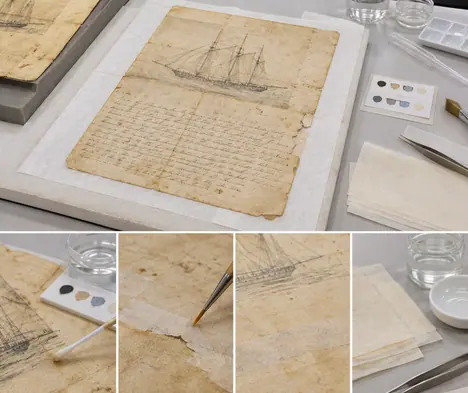
- Arrange treatment assessment. A paper conservator should evaluate deacidification and possible aqueous desalting. Spot tests must check inks and annotations for movement or color change before anyone considers immersion.
- Mend selectively. Following an approved treatment plan, local tears may receive Japanese tissue repairs. Choose the repair and adhesive for the sheet’s condition and sensitivity.
- Provide fitted housing. Use lignin-free, acid-free archival folders and suitable boxes. Housing should support the object without forcing fragile folds flat.
Monitor Moisture Around Suspected Salts
A reasonable planning range for a mixed paper store is 16–20 °C and 40–50% relative humidity, with continuous logging and emphasis on stability. These settings do not halt all deterioration. Different salts absorb moisture and crystallize at different humidities, so a description such as “salt-stained” cannot determine a safe setting by itself.
Suspend Mold-Affected Consultation
If mold is suspected, stop routine consultation, segregate the affected material and obtain conservation advice. Lowering room humidity does not remove existing contamination.
After rehousing, record what changed and what remains vulnerable. The useful outcome is a supported, traceable document with a clear handling procedure, rather than an undocumented claim that treatment has made it safe.
Fund Fragile Originals Before Expanding Scan Counts
Allocate resources from a condition-ranked inventory. Page totals measure scanning output; they say little about whether a vulnerable letter will survive its next consultation.
For a proposed 12-month work plan, prioritize stabilization, fitted housing and storage monitoring for the most vulnerable originals. Use digital surrogates to reduce repeated handling. Review priorities every 3 months against changes in condition, consultation demand and completed housing.
Keep Condition Visible
Track conservation referral, access restrictions and digitization status under the same identifier. Marking an item “scanned” should never automatically change its physical-condition status to “stable.”
Academic Sources
The Library of Congress preservation guidelines for paper and manuscripts provide general care, handling and storage guidance. The Canadian Conservation Institute’s Agents of Deterioration: Incorrect Relative Humidity supplies complementary environmental guidance. Assign treatment decisions to a qualified paper conservator.
When future solo sailors and historians look back a century from now, will we hand them an intact piece of Spray’s voyage—or merely a rendering of an artifact we allowed to turn to dust?