Here is the question that started this log: when a terminal the size of a dinner plate can put a mid-ocean cockpit into a living room ashore in under a second, what is left of the frontier that made solo circumnavigation worth attempting?
Not a philosophical exercise. A practical one, with entries, positions, and a barometer.
Day 14: Sorting the Alerts at 34° South
34° 12' S, 15° 45' W. South Atlantic, moderate trades, the kind of sailing that used to be described as monotonous. The cabin was anything but. Weather routing updates arrived in threads. Messages from shore stacked up behind them. Every chime pulled a head up from the chart table.
So the alerts got audited. One six-hour watch, split into 30-minute blocks, and every audible alert written down against a single test: did this sound change the sail plan, change a collision assessment, or trigger an immediate safety action?
Three columns emerged, and they refused to blur.
- Distress and collision: a registered 406 MHz EPIRB and a transmitting AIS. Both perform their function without inviting a conversation.
- Weather and navigation: forecast products, grib files, bulletin traffic. Useful, and finite.
- Social reassurance: routing replies, message threads, status requests. Every one of them opened a decision loop that ended somewhere on land.
That third column is the whole problem. A routing reply feels like navigation. It behaves like companionship. The distinction only becomes visible when you count the alerts instead of feeling them, because the felt experience of a busy cabin is indistinguishable from the felt experience of a busy passage.
Why the EPIRB Stays Awake
The safety baseline drawn on Day 14 held for the rest of the voyage. An EPIRB and an AIS transponder deliver distress and traffic functions without maintaining a living-room-style feed. Broadband messaging does the opposite: it is available continuously, it is bidirectional, and it will happily supply an opinion about your reefing decision from a sofa nine thousand miles away.
Three Columns, Six HoursBefore silencing any circuit, log every alert for one watch and sort it by function. What survives the sort is your actual safety fit-out. What does not survive is your habit.
Day 22: A Circuit-by-Circuit Shutdown Below 41° South
41° 30' S, 02° 10' E. Eight days from the Day 14 fix, roughly 940 to 970 nautical miles of straight-line separation, which works out near 118 to 121 miles a day before any allowance for tacking, current, or course change. The higher latitudes were beginning to announce themselves in the swell period.
The feed came down here. Not with a master switch on the navigation bus, which is a crude and dangerous instrument, but circuit by circuit.
- Confirm EPIRB self-test status.
- Confirm AIS transmit and receive.
- Confirm the fitted DSC-capable radio is on watch.
- Disable automatic message retrieval.
- Disable recreational browsing and social notifications.
- End shore-based routing exchanges.
Essential equipment stayed energized around the clock. Receive-only safety bulletin checks were confined to two scheduled windows, 0000–0015 and 1200–1215 UTC. Thirty minutes a day of listening, zero minutes of talking. Social and recreational bandwidth stayed dark.
That is the boundary this voyage was built around: preserve every means of raising an alarm, remove every means of borrowing confidence from shore.
What the Society Standard Actually Regulates
The Joshua Slocum Society International has always drawn its line at the hull and the crew list: alone means alone, unassisted means unassisted, and the Solo Circumnavigators Registry records the voyage, not the voyager's state of mind. Safety equipment is expected. Psychological solitude is elective. Nobody will strike your name for keeping a satellite handset live in the Southern Ocean, and nobody should.
Which is exactly why the choice matters. Captain Joshua Slocum had no election to make. Aboard the Spray, isolation was a condition of the ocean, and Sailing Alone Around the World reads the way it does because there was no shore-side voice available to dilute a single decision. The modern sailor has to manufacture that condition deliberately, circuit by circuit, against a device that is designed to be irresistible.
One caution on scope. A voluntary solitude protocol sits underneath the law, never on top of it. Flag-state rules, race instructions, and compulsory watchkeeping all continue to apply. An ordinary private yacht may carry equipment compatible with the GMDSS (Global Maritime Distress and Safety System) without being a SOLAS vessel at all, while other craft carry binding carriage and reporting duties that no personal philosophy overrides. Check which category your hull falls into before you disable anything.
Day 35: The Barometer Every Half Hour in the Roaring Forties
46° 15' S, 35° 20' E. Thirteen days after the power-down. A severe Southern Ocean gale set in, and the pressure began to go.
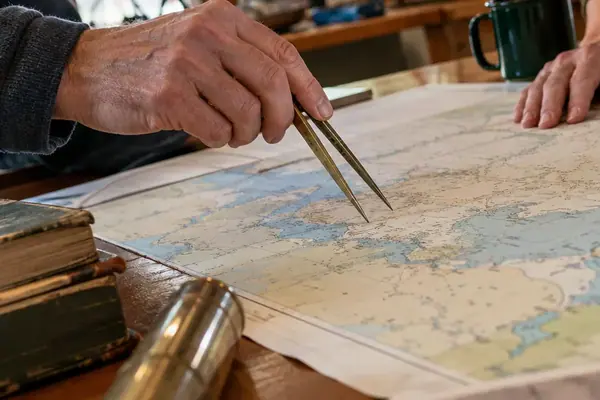
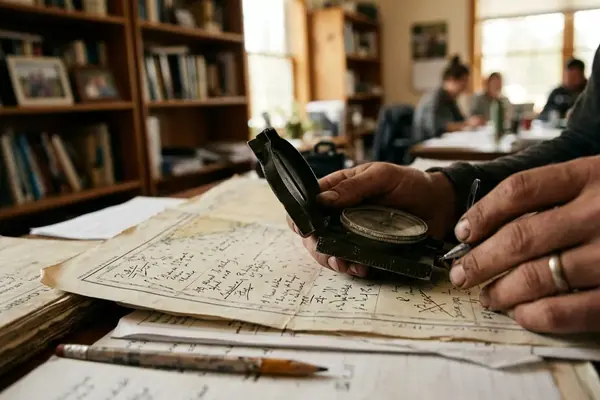
Storm tactics came from what was observable aboard: pressure tendency, wind shift, sea direction, steering load, sea room. The barometer went into the paper log every 30 minutes for six hours, alongside wind direction, heading, sail configuration, bilge condition, and water intrusion. A trend built from twelve consecutive readings is a fact. The sensation of "it's falling fast" is a mood, and moods reef badly.
Here is the physical reality of that nav station, since "severe conditions" tells you nothing. Chart edges gone soft and dark with wet. Condensation beading around the instrument panel and running down the bulkhead in thin lines. A halyard setting up a vibration through the rig at a pitch that changed with every gust. And the interval between breaking crests, which is the number that actually governs whether you can move about the cabin.
The satellite handset stayed in its bracket, treated as an alerting device and nothing more. This is the psychological hinge of the whole passage. A phone in the hand during a Southern Ocean gale delivers the illusion of rescue, and the illusion is expensive: it lets a sailor defer a decision that must be made in the next ten minutes to a person who cannot see the sea state, cannot feel the steering load, and cannot get there.
When the Radome StreamsA moving terminal loses its link when the antenna's view is masked by steep heel, a boarding sea, water on the radome, or heavy precipitation. If you later claim an outage, take it from the terminal event log in one-minute bins. Outages reconstructed from memory after a gale are stories, not data.
There was no shore-based router to confirm the tactical call. There was a pressure trend, a wind shift, and a heading. It turned out to be enough, and finding that out is the entire content of the fourteen days that follow.
Day 42: A Dollar Tin Clock and Fifteen Degrees an Hour
48° 50' S, 70° 12' E. Heavy residual swell, the boat rolling deep and slow, and an equilibrium in the cabin that had not been there on Day 14.
About 1,400 to 1,440 nautical miles of straight-line distance from the Day 35 fix in seven days, around 200 to 206 miles a day. That is a fast hull driven hard, not a typical cruising-cutter run, and the log should say so plainly rather than let the figure pass as ordinary.
The transition to solitude showed up in routine, not in any declaration of courage. Sleep checks resumed on schedule. Sail changes happened without a request for approval going anywhere. Uncertainty went straight into the log as uncertainty, which is a habit that dies quickly when someone ashore is reading over your shoulder.
Position-Finding Without a Feed
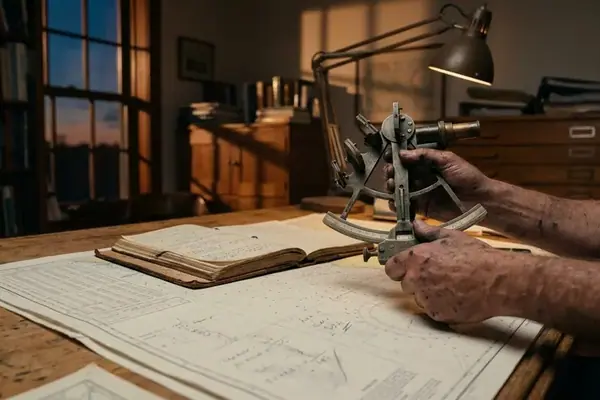
Slocum's navigation makes the cleanest comparison available, because it separates position-finding from continuous connectivity completely. He carried no dependable marine chronometer aboard the Spray. He worked dead reckoning, noon observations, occasional lunar-distance sights, and the nautical tables. The timepiece was a cheap tin clock, described in the accounts as costing one dollar, and it was damaged.
Understand what that instrument was doing. Longitude is a time problem: every four minutes of difference is one degree, every hour is fifteen degrees. The dollar clock supplied approximate time. The lunar observation and the tables supplied the independent astronomical reference that the clock could not.
Fifteen degrees an hour. A man circled the globe alone with a one-dollar clock and the moon, and the modern frontier is measured by how long we can stand to leave the terminal switched off.