Salt Exposure and the Identity of an “1898 Logbook”
Marine salts retained in manuscript paper can sustain moisture and promote deterioration. Dampness may reduce the immediate brittleness associated with very dry paper, while also supporting chemical processes that weaken it. Conservation planning for material associated with Captain Joshua Slocum therefore begins with provenance and material identification.
Slocum’s circumnavigation ran from 1895 to 1898. An accession record should establish whether an “1898 logbook” designation refers to the entries, the manuscript’s compilation, or later cataloguing. Until provenance and examination permissions are established, the procedure below remains an examination proposal rather than a diagnosis of Slocum’s pages.
Readers using the society archives need a traceable connection between a manuscript and the voyage. The archival response begins with accession references, dated descriptions and condition photographs. The resulting record keeps the object’s identity separate from interpretations of its stains. That distinction also supports responsible use of manuscripts alongside the Solo Circumnavigators Registry.
Identify Paper and Ink Separately
Examination should establish the paper furnish rather than assume a wood-pulp and rag mixture from the date alone. Ink identification likewise precedes any claim about a particular shipboard formulation.
Marine chlorides do not simply generate hydrochloric acid during storage. Iron gall ink acidity involves its formulation, iron chemistry and degradation products. These processes deserve separate entries in the examination record.
Tracing Iron Corrosion Through the Ink Strokes
Available iron(II) can react with hydrogen peroxide to generate highly reactive hydroxyl radicals. The simplified Fenton reaction is Fe²⁺ + H₂O₂ → Fe³⁺ + OH⁻ + •OH. Radical attack can sever cellulose chains; acidity promotes cellulose hydrolysis through a separate pathway. Both processes weaken the sheet.
Salts affect the moisture environment around those reactions. Near room temperature, pure sodium chloride deliquesces at approximately 75% relative humidity, while magnesium chloride does so near 33%. These reference values describe individual salts; deposits within historic paper require assessment as mixtures.
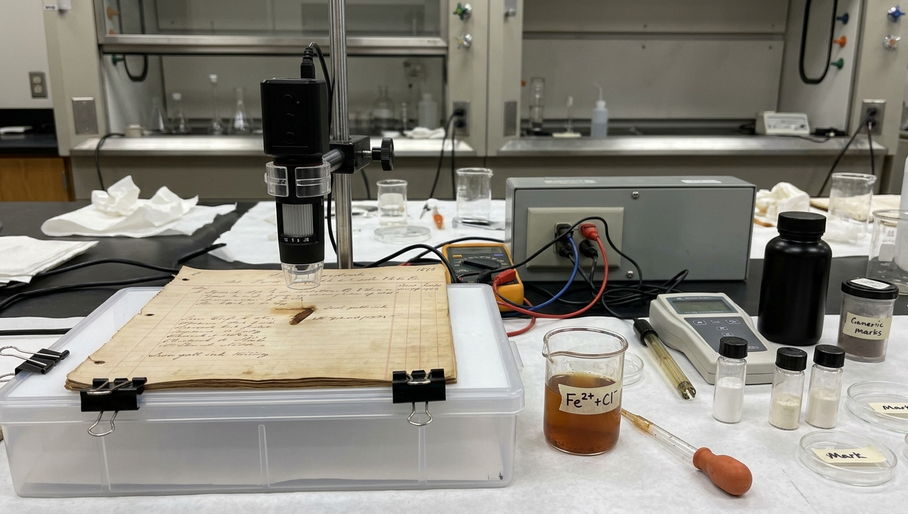
The examiner compares inked strokes, adjacent blank paper and water-stained areas. Brown discoloration following individual letters suggests a different distribution of damage from discoloration extending across a tideline.
- Photograph corresponding locations on the recto and verso.
- Compare visible-light, transmitted-light and low-exposure ultraviolet views.
- Record fluorescence quenching alongside the other observations.
- Map cracks and losses along heavily inked downstrokes before turning the leaf.
Fluorescence quenching requires interpretation alongside material identification and condition evidence. Heavy downstrokes may concentrate ink and become fracture paths. Recording their condition first creates a baseline against which later handling can be checked.
Planning Surface pH Tests and Chloride Analysis
The curator’s first question is practical: will a contact measurement change the treatment decision enough to justify wetting the paper? That question places the manuscript’s physical condition ahead of the convenience of obtaining a meter reading.
Terminology matters. Cold extraction measures an extract prepared from a paper sample. A flat-surface electrode measures a locally wetted surface. Each procedure requires its own authorization and documentation.
- Complete the dry examination. Establish accession details, photograph condition and select possible test locations.
- Define the measurement question. Separate a surface-acidity assessment from an investigation of chloride contamination.
- Calibrate the meter. Use buffers bracketing the expected range, commonly pH 4 and pH 7, and record calibration and measurement temperature.
- Authorize each contact point. Identify blank margins and any ink-associated locations that warrant comparison after sensitivity assessment.
- Record the wetting event. Document water volume in microlitres, contact duration in seconds, electrode position and appearance after drying.
Water can mobilize salts and available iron laterally. Any spreading wetness, transferred discoloration or new tideline calls for immediate documentation and reassessment. Capillary blotting removes accessible liquid; the condition record must also account for migration that has already occurred.
Chloride measurement requires a separate analytical pathway. Ion chromatography of an authorized extract can quantify chloride. Its sampling decision belongs explicitly in the examination plan, alongside the surface-pH procedure.
Selecting Phytate Treatment, Buffering and Kozo Repairs
Treatment selection follows the examination findings. Controlled aqueous washing can remove soluble salts and degradation products. Weak sheets, mobile ink constituents and migrating iron require an assessment of how the particular leaf responds.
Calcium phytate complexes available iron and can reduce its catalytic activity. Established calcium-phytate treatment generally uses an aqueous system. Buffering with calcium bicarbonate also belongs to an aqueous treatment sequence. Magnesium-oxide dispersions represent a different deacidification approach, with their own application considerations.
Separate Chemical Stabilization From Physical Support
Chelation addresses available iron. Buffering addresses acidity. Kozo repairs support damaged paper. Cellulose chains already severed by oxidation or hydrolysis remain damaged, so the treatment record should distinguish chemical aims from mechanical reinforcement.
For thin Japanese kozo tissue applied with hydroxypropylcellulose, record the tissue weight in grams per square metre, adhesive concentration, solvent composition and repair location. An ethanol-containing system requires testing for ink movement, solvent-sensitive components and changes in the paper before application.
The Library of Congress iron gall ink conservation guidelines provide a reference point when preparing the treatment proposal.
The resulting record should connect each intervention to an observed need: a fractured downstroke receives support; an acidity assessment informs buffering; evidence of available iron informs consideration of phytate. Separate decisions make later review more useful.
Preparing a Water-Stained Magellan Gathering for the Vault
A proposed examination of an “1898” gathering describing the Strait of Magellan begins with chronology. Slocum’s passage through the strait belongs to 1896. The catalogue should distinguish the voyage episode, the date of the surviving text and the date of conservation intervention. A later transcription needs its own documented relationship to the voyage.
Before engagement, the examiner maps tidelines, pooled ink, cracks and existing losses. Stains receive location descriptions rather than an assumed origin in cabin leaks aboard the Spray. Ink accumulations receive the same care before anyone attributes them to Slocum re-dipping his nib.
During an authorized treatment, damp-blotter contact requires records of contact duration, blotter changes and the analytical basis for judging extraction. Treatment choices then follow the observed response, including any movement of salts, iron or soluble colorants.
The outcome record pairs before-and-after photographs with every measurement location and method. Custom housing specifications include support-board dimensions, interleaving and enclosure construction. A proposed 40–50% relative-humidity range becomes a monitored specification. An anoxic enclosure requires a separate oxygen-control rationale alongside humidity management.
At the vault bench, the examiner sets the fully dried leaf on its fitted support. The surface-test location is marked on the condition map. Under the loupe, the dark downstroke lies beside its documented repair; the enclosure closes without bending the margin.